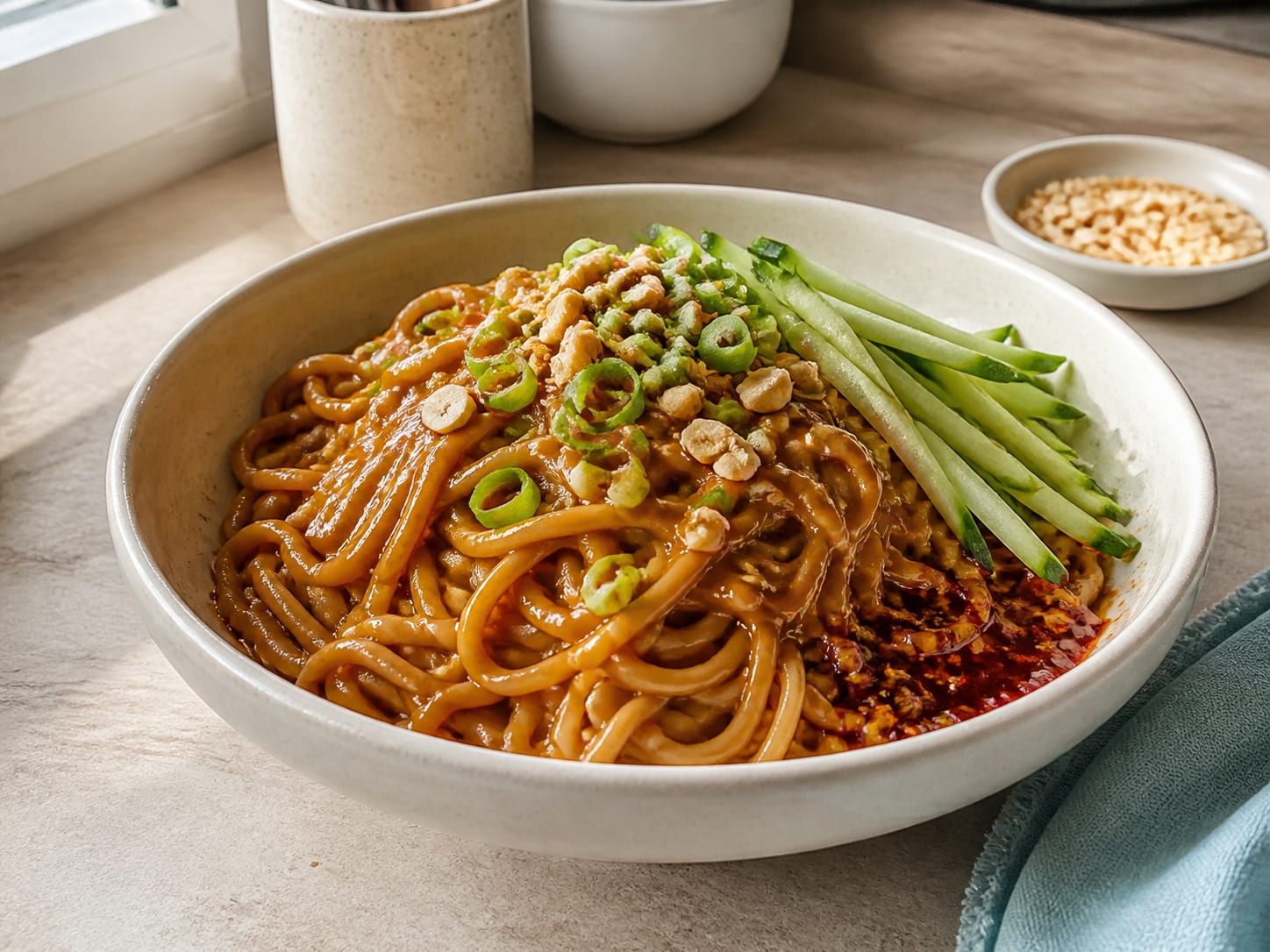
Peanut chili noodles
Wheat noodles in a peanut butter sauce cut with soy, rice vinegar, and chili crisp, thinned with hot noodle water until it coats. Add chicken, pork, or tofu, or leave it plain. Good hot the moment it is tossed and good cold out of the fridge the next day.
Prep10 min
Cook10 min
Servings4
Adapted from America's Test Kitchen chili crisp noodles, The Woks of Life peanut noodles, and Hungry Lankan peanut butter chili oil noodles, with the lineage of the dish checked against Wikipedia
Ingredients
Written for a 5 L pot
Units
Temperature
Servings
Peanut sauce
- 130 g natural peanut butter, smooth, peanuts and salt only rounded
- 45 ml light soy sauce rounded
- 30 ml rice vinegar rounded
- 15 ml toasted sesame oil rounded
- 45 ml chili crisp, with the sediment, or plain chili oil rounded
- 12 g sugar, less or none with sweetened peanut butter rounded
- 3 garlic cloves, grated to a paste rounded
- 15 g fresh ginger, peeled and grated rounded
- 120 ml hot noodle water or chicken stock, added at the end, to loosen rounded
Noodles and to finish
- 400 g fresh Chinese wheat noodles, or 320 g dried, or spaghetti rounded
- to taste fine salt, for the noodle water rounded
- 200 g cucumber, seeded and cut into matchsticks rounded
- 60 g scallions, thinly sliced on an angle rounded
- 40 g roasted peanuts, roughly chopped rounded
- 10 g coriander, leaves and tender stems (optional) rounded
Optional: chicken
- 400 g chicken thigh fillets, sliced 5 mm thick against the grain (optional) rounded
- 15 ml light soy sauce, for the marinade (optional) rounded
- 8 g cornstarch, for the marinade (optional) rounded
- 15 ml neutral oil (optional) rounded
Optional: pork
- 350 g ground pork (optional) rounded
- 15 ml Shaoxing wine, dry sherry also works (optional) rounded
- 10 ml dark soy sauce (optional) rounded
- 15 ml neutral oil (optional) rounded
Optional: tofu
- 400 g firm tofu, pressed 20 minutes and cut into 2 cm cubes (optional) rounded
- 20 g cornstarch, for coating (optional) rounded
- 30 ml neutral oil (optional) rounded
- 10 ml light soy sauce, added off the heat (optional) rounded
Method
- Put a large pot of water on to boil and salt it. While it heats, make the sauce and cook the protein if you are using one.
- Whisk the peanut butter and soy sauce together first, on their own, until the mixture is smooth and stiff. Peanut butter seizes when you hit it with liquid all at once, so bring it together with the soy before anything else goes in.
- Whisk in the rice vinegar, sesame oil, chili crisp, sugar, garlic, and ginger. It will look thick and split. That is correct at this stage.
- Chicken. Toss the sliced chicken with the soy sauce and cornstarch and leave it 10 minutes. Heat the oil in a wide pan over high heat, spread the chicken in one layer, and leave it alone for 2 minutes before stirring. Cook 4 to 5 minutes total, until just cooked through. Tip it onto a plate.
- Pork. Heat the oil over medium-high heat, add the ground pork, and press it flat. Let it brown properly on one side for 3 minutes before breaking it up. Add the Shaoxing wine and dark soy sauce and cook until the liquid is gone and the meat is dark and slightly crisp, about 6 minutes.
- Tofu. Pat the pressed tofu dry, then tear it by hand into rough bite-size pieces instead of cutting cubes. Toss with the cornstarch and shake off the excess. Fry in the oil over medium-high heat, turning only when a face is golden, about 8 minutes total. Off the heat, splash over the soy sauce and shake the pan. The craggy surface holds far more peanut sauce.
- Boil the noodles. Before you drain them, scoop out 250 ml of the cooking water.
- Whisk 120 ml of the hot noodle water into the sauce. It will go from split and stiff to a glossy, pourable cream. Add more, 20 ml at a time, until it drips off the whisk in a ribbon and does not sit in a lump.
- Drain the noodles and put them straight into the sauce while hot. Toss hard for half a minute so every strand is coated.
- Fold through the protein, or spoon it over the top. Finish with cucumber, scallions, peanuts, and coriander.
Notes
- Natural or sweetened peanut butter, and why it matters. Use natural peanut butter, the kind whose label lists peanuts and salt and nothing else. In Germany that is sold as Erdnussmus and lives in the health food aisle at dm, Rossmann, Alnatura, and most Bioläden. The sweetened American style jars sold here, Calvé and Skippy and the supermarket own brands, carry roughly 8 to 10 percent added sugar plus palm fat. If that is what you have, leave the 12 g of sugar out entirely and taste before you add any back. Skip that check and the sauce lands sticky and candy-sweet, which is the single most common way this dish goes wrong.
- Hot or cold. Serve it hot when you are eating it the minute it is tossed, and especially with the chicken or pork, where a warm bowl keeps the fat soft. Serve it cold or at room temperature when you made it ahead, when you are packing it for lunch, or when it is 30 degrees outside. Cold peanut sauce tightens hard in the fridge, so loosen it with 2 to 3 tablespoons of water and a squeeze of lime before you eat it, and season again. Cold food needs more salt and more acid than hot food to taste the same.
- Where this dish comes from. It is not a Chinese regional recipe and it is not pretending to be one. Peanut butter noodles descend from the Hong Kong reworking of Sichuan dan dan noodles, which added sesame paste and peanut butter and dialled the chili down, and that version is what Western Chinese restaurants inherited and what became the American peanut noodle. See the dan dan recipe in this archive for the original. This one is honest about being a hybrid, and it is a good one.
- Chili crisp. Make the chili crisp in this archive if you have an hour. Otherwise Lao Gan Ma is in every German Asia-Markt in the squat jar with the woman’s photograph on it, and it works. Use the sediment, not just the oil off the top, or the sauce has heat and no texture.
- Vinegar. Rice vinegar keeps the sauce clean. Chinkiang black vinegar makes it darker and maltier and moves it toward dan dan territory, which is also good. Do not use white wine vinegar, it is too sharp and reads sour rather than bright.
- Failure modes. Adding all the liquid at once splits the sauce. Draining the noodles too long before tossing lets them glue together and the sauce then sits in patches. And a sauce that looks right in the bowl often looks thin on the noodles, so aim for slightly thicker than you think.
- Leftovers. Keeps three days. The noodles absorb sauce overnight, so hold back a couple of spoonfuls of the sauce before tossing if you know you are eating half of it tomorrow.
Sources used
- America’s Test Kitchen: Chili Crisp Noodles
- The Woks of Life: Peanut Noodles
- Hungry Lankan: Peanut Butter Chili Oil Noodles
- Wikipedia: Dandan noodles
Good with
- Chili crisp
- Dan dan noodles
- Gado-Gado (Indonesian salad with peanut sauce)
- Garlic-ginger bok choy
- Quick sesame cucumber salad
Sources consulted
From Christoph Mayer