
Main Indonesian Southeast Asian Vegetarian option Dairy-free
Gado-Gado (Indonesian salad with peanut sauce)
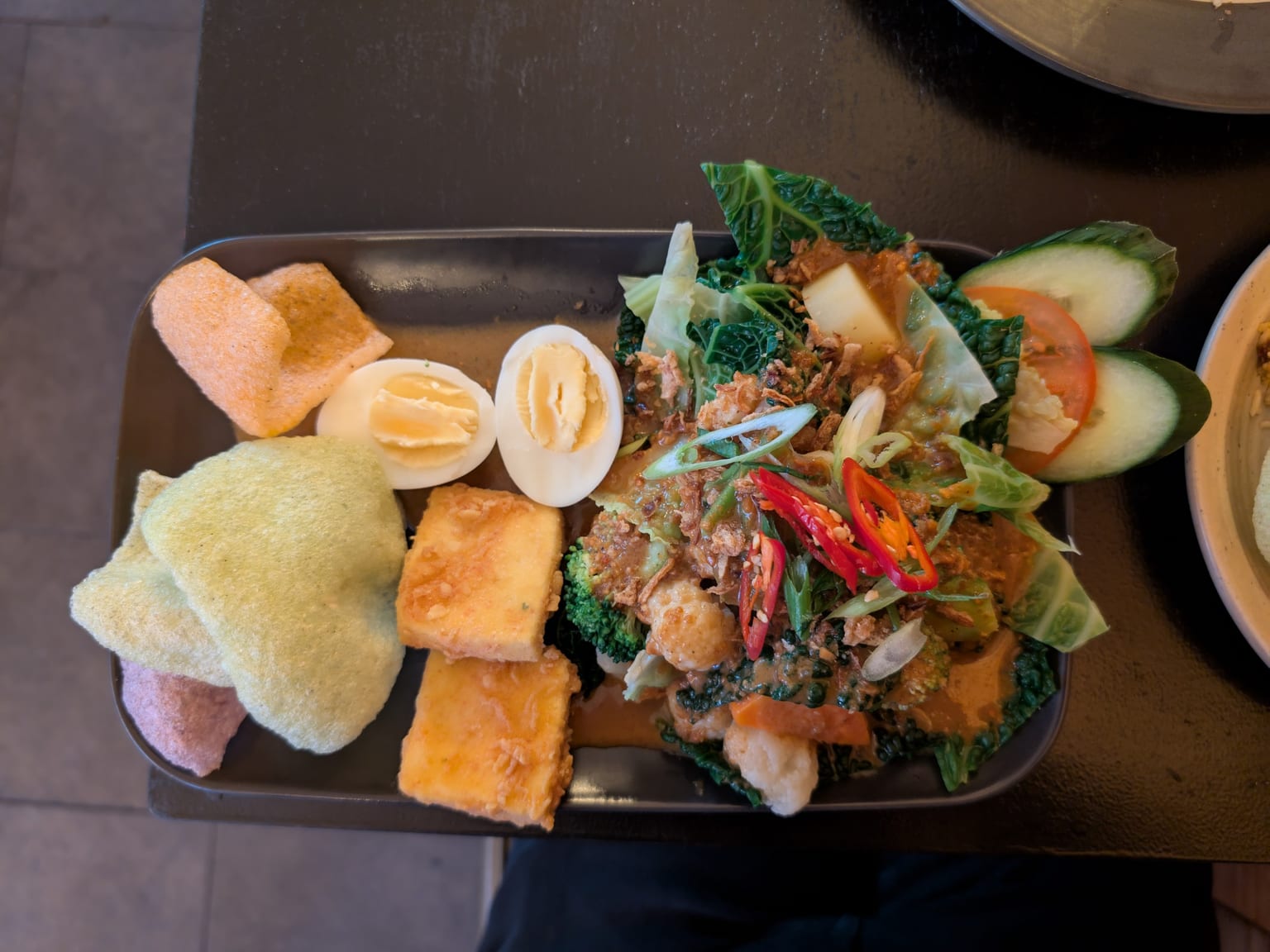
The Indonesian composed salad whose name means roughly mix-mix. Blanched vegetables, boiled potato, egg, fried tofu and tempeh, and cucumber under a thick peanut sauce built on palm sugar, tamarind, and kecap manis, with fried shallots over the top. Filed as a main rather than a salad because with the potato, egg, and tofu in it, it is the whole meal in Indonesia and it eats like one here too.
Adapted from Daily Cooking Quest, Maangchi, and Caroline's Cooking, with the background on sambal kacang and regional variation from America's Test Kitchen
Ingredients
Written for a 4 L pot
Peanut sauce, sambal kacang
- 250 g roasted unsalted peanuts, skins rubbed off rounded
- 30 ml neutral oil, for frying the aromatics rounded
- 4 garlic cloves rounded
- 3 red bird's eye chiles, seeded for less heat, or use more rounded
- 8 g terasi, Indonesian shrimp paste, toasted rounded
- 45 g palm sugar, gula jawa, chopped or grated rounded
- 20 ml tamarind paste, the pourable concentrate rounded
- 30 ml kecap manis, Indonesian sweet soy sauce rounded
- 15 ml lime juice, added at the end rounded
- 5 g fine salt rounded
- 300 ml hot water rounded
The salad
- 400 g waxy potatoes, boiled in their skins, peeled, cut into thick slices rounded
- 4 eggs, boiled 8 minutes, peeled, halved rounded
- 300 g firm tofu and tempeh, half and half, cut into 1 cm slabs, patted dry rounded
- 300 ml oil for frying, about 1 cm depth in a small pan rounded
- 200 g green beans, cut into 5 cm lengths rounded
- 200 g white cabbage, shredded rounded
- 150 g mung bean sprouts rounded
- 150 g spinach, water spinach, kangkung, if you find it rounded
- 200 g cucumber, raw, sliced rounded
- 20 g fried shallots, bawang goreng rounded
- 40 g krupuk, prawn crackers or emping, to serve (optional) rounded
Dietary labels are a guide, not a guarantee. If you have an allergy, read the ingredients yourself.
Method
- Boil the potatoes in their skins until a knife goes in easily, about 20 minutes. Boil the eggs 8 minutes and drop them into cold water. Peel both.
- Bring a pot of salted water to the boil. Blanch each vegetable separately and briefly: green beans 3 minutes, cabbage 2 minutes, bean sprouts 30 seconds, spinach 20 seconds. Lift each out with a spider into cold water, then drain hard. Separately is not fussiness, they cook at completely different speeds and mushy bean sprouts ruin the plate.
- For the best texture, simmer the tofu whole for 3 minutes in salted water first (see the tofu prep formula). Tear it by hand into rough 3 cm pieces so the peanut sauce has craggy edges to cling to; slice the tempeh into neat 1 cm pieces because it is already textured. Heat 1 cm of oil in a small pan and fry both in batches until deep golden, about 4 minutes a side. Drain on paper and salt lightly while hot.
- Toast the terasi: wrap it in foil and press it in a dry hot pan for a minute a side, or toast it directly in the pan until it smells sharp and fishy. Raw shrimp paste tastes flat and slightly muddy, toasted it tastes savoury.
- Warm the 30 ml of oil in a small pan and fry the garlic and chiles over medium heat for 2 minutes, until soft and fragrant but not browned.
- Grind the peanuts, fried garlic and chiles, toasted terasi, palm sugar, and salt to a coarse paste. A food processor is fine. Stop while it is still slightly gritty, gado-gado sauce is not meant to be as smooth as satay sauce.
- Scrape it into a bowl and stir in the tamarind and kecap manis. Add the hot water 100 ml at a time, stirring, until the sauce is thick enough to sit on a spoon and drop off slowly. Finish with the lime juice, then taste. It should read sweet first, then salty, then sour, with the heat behind. Adjust with palm sugar, salt, or tamarind.
- Arrange everything on a large platter in sections: potato, blanched vegetables, cucumber, tofu and tempeh, eggs. Do not toss it.
- Spoon a good amount of sauce over the top and put the rest in a bowl on the table. Scatter the fried shallots. Serve the krupuk alongside.
Notes
- Why it is a main and not a salad. Potato, egg, fried tofu, tempeh, and a peanut sauce heavy enough to stand a spoon in. In Indonesia this is lunch, sold from carts and warungs as a complete meal, often with lontong, compressed rice cake, added to it. Serve it as a side to something else and you have a very odd dinner.
- Kecap manis in Germany. Widely available. The ABC brand from Indonesia is the standard, sold as Ketjap Manis or süße Sojasauce in Asia-Märkte, in Dutch and Indonesian Toko shops, and online through Reishunger, asia-foodstore, and toko24. If you are stuck, simmer 3 parts dark soy sauce with 2 parts dark brown sugar or molasses until it is syrupy and pourable, then cool. It is close enough.
- Tamarind in Germany. Asia-Märkte sell Tamarindenpaste or Tamarindenmark, either as a pourable concentrate in a jar or as a compressed block of pulp with seeds. If you buy the block, soak 30 g in 60 ml of hot water, squash it with your fingers, and push it through a sieve. Turkish shops are the other good source, where it is sold as demirhindi, sometimes as a sour syrup. Lime juice alone is not a substitute, tamarind is sour and also fruity and slightly molasses-like, and the sauce goes flat without it. If you genuinely have none, use 15 ml lime juice plus 5 g extra palm sugar and accept it is a different sauce.
- Terasi in Germany. Sold as terasi, or as belacan under Malaysian brands, in a hard dry block wrapped in paper, sometimes labelled Garnelenpaste. It smells alarming and tastes fine once toasted and diluted. Thai kapi in a tub is a workable stand-in at the same weight. For a vegetarian version, leave it out, add 10 ml of light soy sauce and a little extra salt, and know that you are losing the funk that holds the sauce together. Mushroom powder or a spoonful of white miso covers some of the gap.
- Palm sugar. Gula jawa or gula merah, sold in hard brown discs or cylinders. Chop it with a knife or grate it. Dark muscovado is the closest German supermarket substitute, ordinary brown sugar is acceptable.
- Peanuts or peanut butter. Whole roasted peanuts ground coarse give the texture this sauce is supposed to have. If you want the shortcut, use 200 g of natural unsweetened peanut butter plus 50 g of coarsely chopped roasted peanuts stirred in at the end, and cut the palm sugar to 35 g. Do not use a sweetened supermarket peanut butter here, the sauce is already sweet and it tips over.
- A short simmer in salted water before tearing the tofu firms it faster than pressing and seasons it at the same time; see the tofu prep formula.
- Tempeh. Now stocked in most German Bioläden and in the vegan chiller at larger Rewe and Edeka stores. It is worth using alongside the tofu rather than instead of it, the two have completely different textures and the contrast is half the point.
- Failure modes. Blanching everything in one go, which overcooks the sprouts and spinach. Not drying the vegetables, which waters the sauce down on the plate. And making the sauce too thin: it should be noticeably thicker than a satay dipping sauce, because it has to cling to wet vegetables.
- Make ahead. The sauce keeps a week in the fridge and thickens as it sits, so loosen it with hot water and re-check the lime and salt. Blanch the vegetables the morning of. Fry the tofu and tempeh at the last minute, they go leathery in the fridge.
- Leftovers. Chop everything together, sauce and all, and eat it cold the next day with rice. It is no longer a composed plate but it is a very good lunch.
Sources used
- Daily Cooking Quest: Gado-Gado
- Maangchi: Gado-gado
- Caroline’s Cooking: Gado gado
- America’s Test Kitchen: The Glories of Indonesian Gado Gado
Good with
From Christoph Mayer