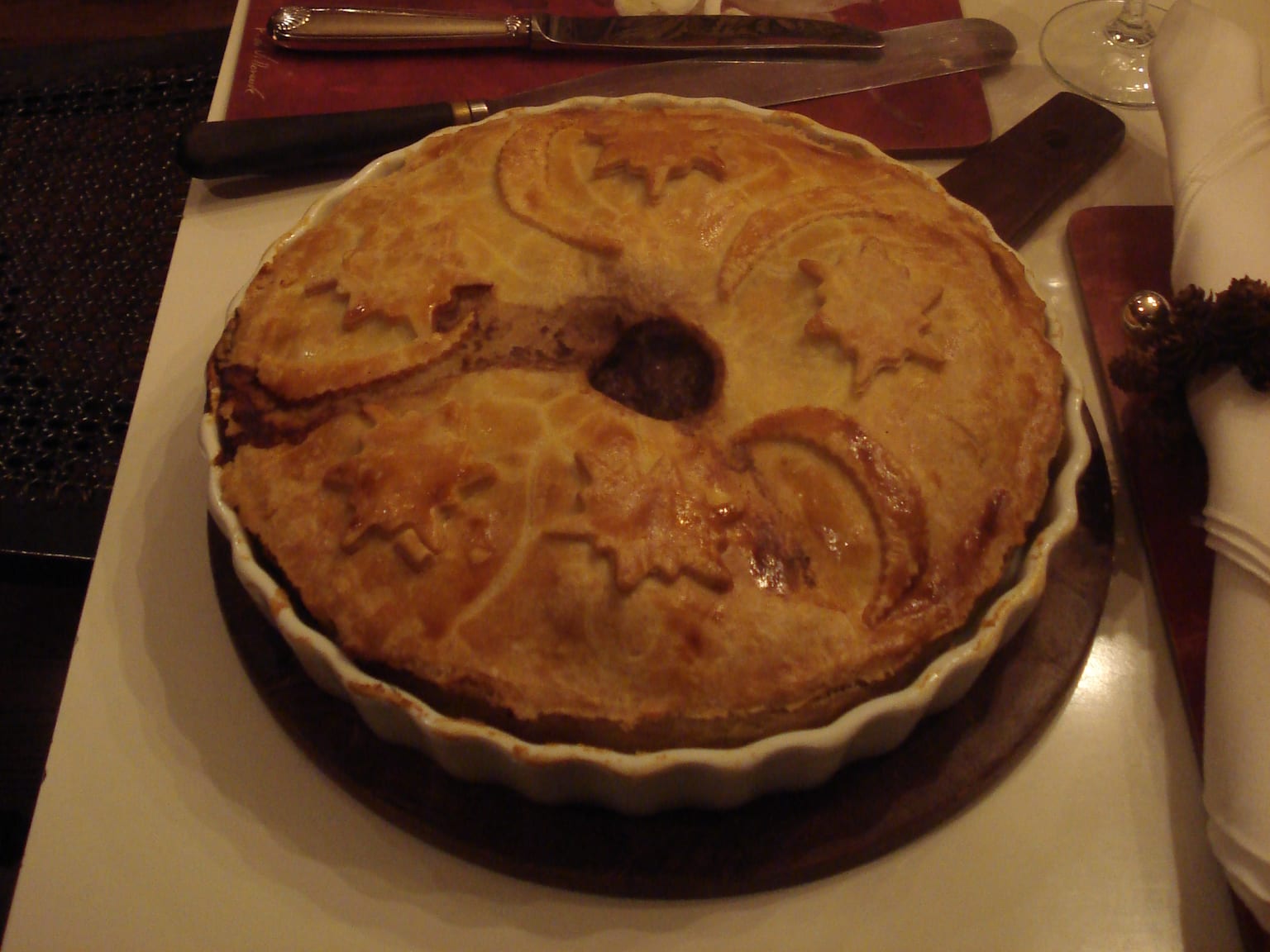

Tourtière (Québec meat pie)
The Québécois meat pie eaten at Réveillon on Christmas Eve. Ground pork and beef simmered with onion, cinnamon, clove, allspice, and summer savory, bound with mashed potato, in a lard and butter double crust. This is the flat Montréal style pie; the deep Lac-Saint-Jean version is a different dish and is described in the notes.
Built from the Recettes Québécoises tourtière de porc and the Radio-Canada Mordu Réveillon collection for the spice profile and simmering method, with the bread and potato binder question settled against the Schmidty Wife version. The regional split checked against Canadian Geographic and the Encyclopédie du patrimoine culturel de l'Amérique française, and the Lac-Saint-Jean notes against Wikipedia. Summer savory identification from Gernot Katzer's spice pages.
Ingredients
Written for a 23 cm round tin
Pastry
- 350 g plain flour rounded
- 8 g fine salt rounded
- 150 g unsalted butter, very cold, diced rounded
- 75 g lard, cold, in small lumps rounded
- 110 ml ice water, hold back the last 20 ml rounded
- 10 ml white wine vinegar rounded
- 1 egg, beaten with a splash of milk, for the glaze rounded
Filling
- 20 g butter rounded
- 200 g onion, finely chopped rounded
- 2 garlic, finely chopped rounded
- 700 g ground pork, not lean, around 20% fat rounded
- 250 g ground beef, or ground veal rounded
- 300 ml chicken or pork stock rounded
- 250 g floury potatoes, peeled weight, boiled and mashed without milk or butter rounded
- 3 g dried summer savory, the signature herb, do not leave it out rounded
- 3 g ground cinnamon rounded
- 2 g ground allspice rounded
- 1 g ground cloves, about a quarter teaspoon, measure it rounded
- 0.5 g freshly grated nutmeg (optional) rounded
- 8 g fine salt rounded
- 2 g black pepper, freshly ground rounded
Method
- Make the pastry first, ideally the day before. Cut the cold butter and lard into the flour and salt until the fat is between pea and lentil size. Mix the vinegar into 90 ml of the ice water, add it in three goes, and toss with a fork. Add the last 20 ml only if the dough will not hold together when squeezed. German flour takes less water than the Canadian flour these recipes were written for.
- Divide the dough two thirds and one third, press both into flat discs, wrap, and chill at least an hour. The larger piece is the base.
- Melt the butter in a wide heavy pot over medium heat and cook the onion with a pinch of salt for 8 minutes, until soft and translucent with no colour. Add the garlic for the last minute.
- Turn the heat up, add both meats, and break them up with a wooden spoon. Cook 8 to 10 minutes, until no pink is left and the fat has rendered. Do not brown it. This is not a ragù; you want pale meat and clean spice, and a hard sear puts a Maillard flavour in that fights the cinnamon.
- Stir in the savory, cinnamon, allspice, cloves, nutmeg, salt, and pepper, and cook 1 minute so the spices bloom in the fat. Pour in the stock, scrape the bottom, and bring to a bare simmer.
- Simmer uncovered 40 to 45 minutes, stirring every 10, until the liquid has reduced to a shallow layer of glossy fat and juice around the meat. The test: drag the spoon across the bottom and the channel should hold for two seconds before closing. Too wet and the bottom crust goes to paste; bone dry and the pie eats like sawdust.
- Boil the potatoes until they collapse against a fork, drain, and mash them plain with nothing added. Stir them into the meat off the heat. They will drink the last of the liquid and hold it there, which is the whole job.
- Taste and adjust now, while it is warm. Cold filling always tastes underseasoned, so aim for slightly too salty and slightly too clove-heavy. Cool it completely, at least an hour, ideally overnight in the fridge. Warm filling melts the base crust before it ever reaches the oven.
- Heat the oven to 200°C, conventional, with a rack on the lowest shelf and a baking tray on it. Roll the larger disc to 3 mm and line the 23 cm tin, letting the edge overhang. Fill with the cold meat and level it, pressing gently into the corners so there are no voids. It should be slightly domed.
- Roll the smaller disc, lay it over, trim both to a 1 cm overhang, fold under, and crimp. Cut three or four clean steam vents through the centre, not decorative slashes near the rim. Brush with the egg glaze.
- Bake on the hot tray on the lowest shelf for 20 minutes at 200°C, then drop to 180°C for a further 35 to 45 minutes. It is done when the top is deep golden brown and the crust in the vents looks dry and set, not pale and damp. If the rim colours before the middle, cover the rim with strips of foil and keep going.
- Rest 30 to 60 minutes before cutting. A tourtière cut hot slumps. At warm room temperature the slices stand up, which is how it is served on the Réveillon table anyway, alongside ketchup aux fruits or a sharp pickle.
Notes
- Summer savory is the ingredient people skip, and it is the one that makes it taste Québécois. Sarriette, Satureja hortensis, tastes like thyme with a peppery edge on top. Without it a tourtière tastes like a spiced pork pie; with it, it tastes like a tourtière. The good news for anyone cooking this in Germany: it is called Bohnenkraut, it is in every supermarket spice rack for about a euro, and it grows in any Baden-Württemberg garden. Germans use it for green beans and lentils and rarely for anything else, so nobody thinks of it as a meat spice, which is exactly why it is easy to find and cheap. Buy the dried leaves, not a powder. Fresh works too; use three times the weight and add it in the last 10 minutes of the simmer. Thyme is the fallback if you genuinely cannot get it, but it is a substitute, not an equivalent, and you should add a few grinds of extra pepper to compensate.
- The regional split is real and I picked a side. This recipe is the flat, double crust, ground meat pie of Montréal and Québec City, which is what most Québécois households make and what most Canadians mean by tourtière. The other dish, tourtière du Lac-Saint-Jean, is not a variation of it. It is a deep casserole lined with pastry, filled with layers of cubed pork, beef, veal, and often game (moose, hare, partridge) plus cubed potato and onion, topped with a thick lid of dough, filled with broth, and baked slowly for six to eight hours at about 120°C. It serves ten or more and it descends from the English sea pie, cipaille, which came up from the Gaspé with settlers around the 1850s. Confusingly, people from Saguenay call that one tourtière and call this flat one pâté à la viande. If you want the Lac-Saint-Jean version, the changes are total, not marginal: cube 1.5 kg of mixed meats and marinate them overnight in the same spice mix, use 1 kg of cubed potato, layer meat and potato in a deep pot lined with a thicker 5 mm crust, pour in enough hot stock to just cover, seal with a lid of pastry, cut one central vent, and bake covered at 120°C for 6 hours, topping up with hot stock through the vent whenever it looks dry, then uncovered for the last 45 minutes to brown.
- The spicing is the signature, and the clove is the tripwire. Cinnamon, clove, allspice, and savory is the classic four. Some families add nutmeg, some add mace, a few add a pinch of ginger. The proportions matter more than the list. Clove at 1 g for a kilo of meat is right; at 3 g the pie tastes medicinal and no amount of resting fixes it. Measure the clove, do not shake it in. Cinnamon should be present but not identifiable as cinnamon by a guest who has not been told. If you can name the spices individually, there is too much of everything.
- Binder: potato, bread, or nothing. All three are traditional in different households. Mashed potato is the most common in Québec and gives the tightest slice; it is what I use. Dried bread cubes or breadcrumbs, about 60 g soaked in the cooking liquid, give a looser, coarser filling with a slightly bready flavour and are common in Acadian and New England Franco families. No binder at all is possible if you reduce the liquid further, but the slices crumble. Grated raw potato stirred in before the simmer is a fourth route and thickens as it cooks, but it can go gluey.
- Meat. Pure pork is orthodox and delicious. Pork with a quarter beef, which is what this recipe does, gives a firmer, less fatty slice and is the more common household version. Veal in place of the beef makes it milder and paler. Use fatty pork, around 20% fat: German Schweinehackfleisch from the Metzger is usually right, but the vacuum packed Hackfleisch gemischt from a supermarket is often too lean and the filling turns dry. Ask for grob durchgedreht if the butcher will do it; a coarser grind eats better.
- German shopping list. Almost all of it is easy. Bohnenkraut, Zimt, Piment, and Nelken are supermarket spices. Schweineschmalz is on the refrigerated shelf next to the butter or at any Metzger, and it makes a better crust than shortening does. Use Type 550, not 405: 405 is closer to a pastry flour and gives a crust too fragile to lift a dense meat pie out of the tin. Mehligkochende Kartoffeln are what you want for the mash, not festkochend. The only thing that is genuinely hard to find is ketchup aux fruits, the sweet and sour tomato relish Québec serves with it; a good Sauerkirsch or plum chutney, or German Gewürzgurken, does the same job of cutting the fat.
- Make ahead and freezing. This is a freezer pie by design, which is why every Québécois family makes four at a time in December. Assemble it raw, do not glaze it, wrap it in two layers, and freeze up to three months. Bake from frozen at 200°C for 30 minutes then 180°C for 60 to 70 minutes, glazing it once the top has thawed enough to take the brush. A baked pie also freezes and reheats at 160°C for 40 minutes, but the crust is never quite as good.
- Réveillon. It is eaten after midnight mass on Christmas Eve, alongside ragoût de boulettes, tourtière’s cousin, and pâté. Plenty of Québécois will tell you eating it in July is wrong. The origin is genuinely disputed: the name may come from the tourte, the now extinct passenger pigeon, or simply from the shallow dish of the same name, and the dish descends from medieval French tourtes brought to New France. Nobody has settled it.
Sources used
- Recettes Québécoises: Tourtière de porc
- Radio-Canada Mordu: 14 tourtières et pâtés à la viande en prévision du réveillon
- The Schmidty Wife: Tourtière with summer savory and a bread binder
- Canadian Geographic: The meat and potatoes of Quebec’s beloved tourtière
- Encyclopédie du patrimoine culturel de l’Amérique française: Lac-Saint-Jean tourtière
- Wikipedia: Tourtière du Lac-Saint-Jean
- Gernot Katzer’s Spice Pages: Savory, Satureja hortensis, Bohnenkraut, sarriette
Good with
From Christoph Mayer