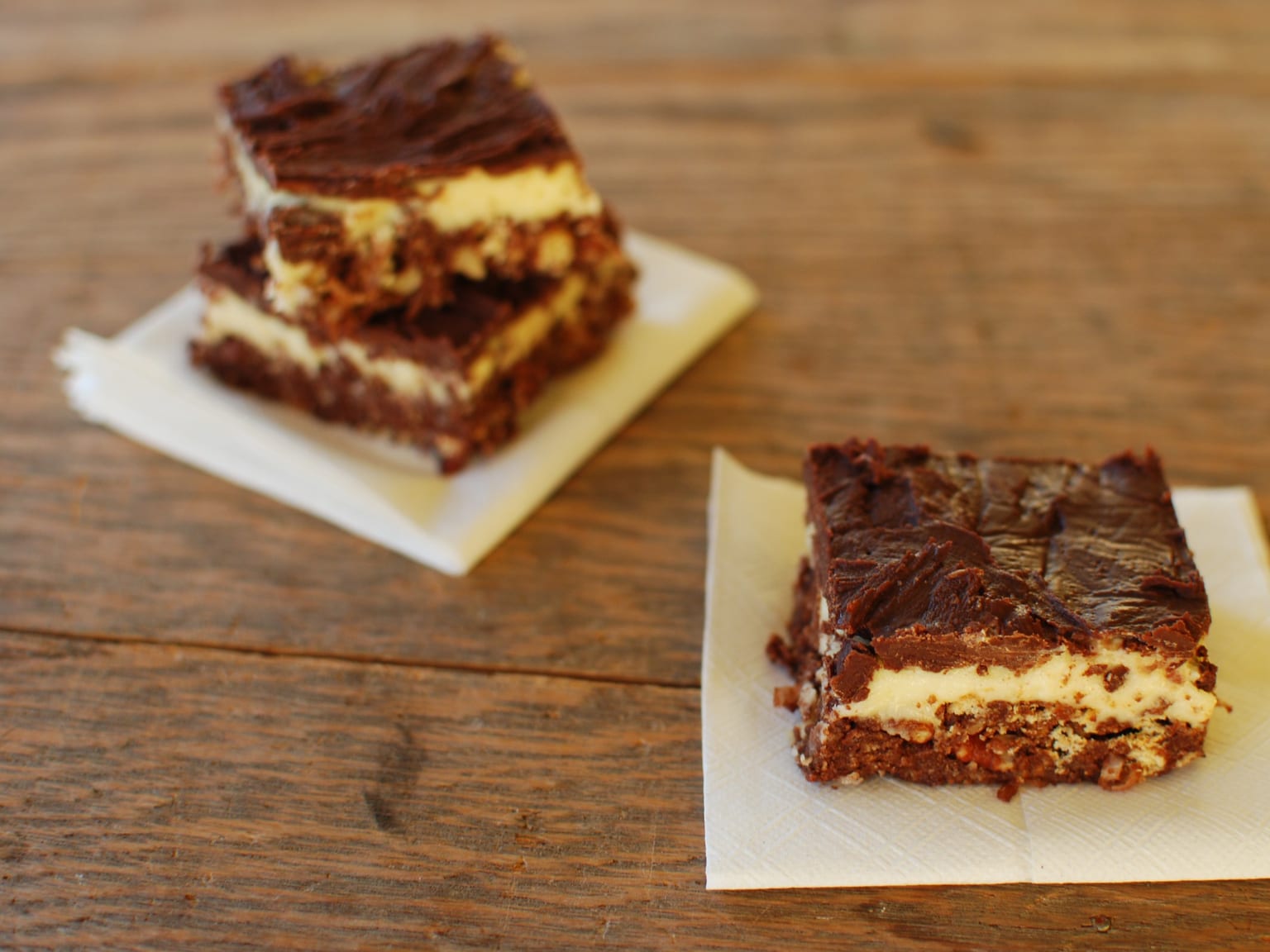

Nanaimo bars
The three layer no-bake bar from Nanaimo, British Columbia. A cocoa, coconut, walnut, and graham crumb base bound with a cooked egg custard, a stiff custard powder buttercream in the middle, and a thin set chocolate top. Written to be made from a German supermarket, with the graham crumb, custard powder, and shortening problems solved.
Built on Joyce Hardcastle's 1986 contest winner as published by the City of Nanaimo, which is the reference standard, with gram weights cross-checked against Seasons and Suppers and House of Nash Eats, the base and topping ratios sanity-checked against the Helvetic Kitchen version written for European ingredients, and the history taken from Wikipedia. German substitutions worked out from Bahlsen and Fddb nutrition data, Nutmeg and Pancakes on Crisco versus Palmin, and Gernot Katzer's spice pages.
Ingredients
Written for a 20 × 20 cm dish
Base
- 115 g unsalted butter rounded
- 50 g granulated sugar rounded
- 30 g unsweetened cocoa powder, Dutch process, sifted rounded
- 1 egg, size M, beaten rounded
- 210 g graham cracker crumbs, in Germany, crushed Vollkorn Butterkekse rounded
- 85 g desiccated coconut, unsweetened rounded
- 60 g walnuts, finely chopped rounded
- 1 g fine salt rounded
Custard buttercream
- 115 g unsalted butter, soft, at room temperature rounded
- 20 g vanilla custard powder, Bird's, or German Puddingpulver zum Kochen, unsweetened rounded
- 40 ml whipping cream rounded
- 240 g icing sugar, sifted rounded
Chocolate top
- 115 g dark chocolate, 50 to 55% cocoa, chopped rounded
- 30 g unsalted butter rounded
- 10 ml neutral oil, rapeseed or sunflower, insurance against a cracking top (optional) rounded
Dietary labels are a guide, not a guarantee. If you have an allergy, read the ingredients yourself.
Method
- Line the 20 by 20 cm pan with baking parchment, letting it hang over two opposite sides. You will lift the whole slab out by those flaps later. Do not grease the pan, and do not skip the parchment: cutting these in the pan is how the top cracks.
- Melt the butter, sugar, and cocoa in a bowl set over barely simmering water. Stir until the sugar has dissolved and the mixture is smooth and glossy.
- Whisk the beaten egg in a thin stream into the warm cocoa mixture, whisking the whole time. Keep the bowl over the water and stir for 2 to 3 minutes. It is done when it thickens to the body of a loose pudding and coats the back of a spoon. If it looks grainy or you see specks of set white, the water underneath was boiling. Take it off, whisk hard, and push it through a sieve. It will still work.
- Off the heat, stir in the crumbs, coconut, walnuts, and salt. Press the mixture into the lined pan with the flat bottom of a glass. Press hard. A loosely packed base crumbles under the knife and drags the custard layer with it. Chill 20 minutes.
- Beat the soft butter with the custard powder until smooth, then add the icing sugar in two additions with the cream, and beat 2 to 3 minutes until pale and thick. Aim for a stiff piping consistency, the kind that holds a peak. Add more cream only a teaspoon at a time and only if it will not come together at all.
- Spread the custard layer over the chilled base and level it with an offset spatula. Chill 30 minutes, until it is firm to a fingertip and does not dent.
- Melt the chocolate with the butter and the oil over the same pot of hot water, stirring until smooth. Let it cool for 5 minutes, until it is still pourable but no longer hot. Hot chocolate melts the top of the custard layer and gives you a muddy line between the two.
- Pour the chocolate over the custard and tilt the pan to spread it. Work fast and use as few strokes as possible. Refrigerate 20 minutes, no longer.
- This is the step that saves the top. At 20 minutes the chocolate is set but still soft under a knife. Lift the slab out on the parchment and score the cutting lines with a long thin knife, pressing just through the chocolate, into a 4 by 4 grid. Return it to the fridge for at least another 2 hours.
- Cut through the scored lines with a long knife dipped in hot water and wiped dry between every cut. Let the bars stand 10 minutes at room temperature before serving. Straight from the fridge the custard layer is waxy and the base is hard.
Notes
- Graham crumbs in Germany. Take the folklore about halving the butter with a grain of salt: the numbers are closer than people say. Graham crackers run about 11 g fat and 25 g sugar per 100 g, Leibniz Butterkeks about 12 g fat and 21 g sugar. So the fat and sugar in the base need no adjustment at all. What is genuinely missing is the whole wheat flour and the faint molasses note that gives graham its character, and the fix for that is the biscuit, not the ratio. Use Leibniz Vollkorn Butterkeks, or a 50/50 mix of plain Butterkeks and any Vollkornkeks. Crush them in a food processor to a sandy crumb with a few larger pieces left in. If all you have is plain Butterkeks, stir 1 teaspoon of Zuckerrübensirup or dark honey into the melted butter mixture and drop the sugar to 40 g. That gets the flavour, not the texture. Do not use Spekulatius, the spice fights the cocoa.
- Custard powder in Germany. Bird’s is cornflour, salt, colour, and flavouring, with no sugar in it. German Puddingpulver zum Kochen, the standard 37 g Dr. Oetker sachet, is the same thing: starch, vanilla flavouring, beta-carotene, no sugar. It is a direct one for one swap, and 20 g is a bit over half a sachet. What you must not use is the instant kind, sold as Puddingpulver ohne Kochen or Paradiescreme. Those are pre-sweetened and pre-milked, and they will turn the layer sickly and slack. Speisestärke alone gets you the texture but none of the vanilla and none of the yellow, which is a large part of what a Nanaimo bar looks like.
- Shortening. The official Nanaimo recipe has none, which surprises people. Where it turns up in other versions is the chocolate top, a spoonful stirred in to keep the layer cuttable. If you want that effect in Germany, use 10 ml of neutral oil, not Palmin. Palmin and Palmin Soft are coconut and palm fat and they set hard well above fridge temperature, so they make the cracking worse rather than better. Palmin Soft is a fine Crisco substitute in a pie crust; it is the wrong tool here.
- Failure mode one, the top cracks when you cut it. The cause is a thin brittle sheet of set chocolate bridging a firm base. The three fixes stack: score the grid at the 20 minute mark while the chocolate still gives, add the tablespoon of oil so the set layer stays slightly plastic at 4°C, and let the cut bars come up to about 15°C before anyone picks one up. A hot dry knife does the rest. Sawing at a fully chilled slab, straight down, in the pan, is a guaranteed shattered top.
- Failure mode two, the middle squeezes out the sides. That is a middle layer that was too soft when it went under the chocolate. The ratio here is deliberately stiff, about two parts icing sugar to one part butter by weight, with only 40 ml of cream. Every extra spoon of cream or milk you add to make it easier to spread costs you at the bite. If it is too firm to spread, warm the offset spatula in hot water instead of loosening the cream. And chill it properly at step 6: the chocolate has to go onto a set layer, not a soft one.
- Walnuts or almonds. Joyce Hardcastle’s winning recipe says finely chopped almonds and that is the letter of the official version. Walnuts are what most Canadian kitchens actually use and what most bakeries sell, and the slight bitterness holds up better against the icing sugar. Pecans work too. Toast whichever you use for 6 minutes at 170°C and cool them first; raw nuts in a no-bake bar taste of nothing.
- Coconut. Kokosraspel from any German supermarket is unsweetened and is exactly right. North American shredded coconut is often sweetened; if you are making these in Canada, buy the unsweetened kind or drop the base sugar to 35 g.
- Chocolate. 50 to 55% is the target. Anything at 70% or above sets harder, tastes lean next to the icing sugar, and cracks more. German Zartbitter is usually around 50%, which is correct as sold. Semi-sweet chips are not the same as bar chocolate and give a duller top.
- Keeping. Five days covered in the fridge, three months frozen. Freeze them cut, on the parchment, in a tin with layers between. They defrost in 20 minutes and are one of the few frozen desserts that genuinely does not suffer.
Sources used
- City of Nanaimo: The Legendary Nanaimo Bar, Joyce Hardcastle’s 1986 contest winner
- Seasons and Suppers: Nanaimo Bars
- House of Nash Eats: The BEST Authentic Nanaimo Bars
- Helvetic Kitchen: Nanaimo Bars, written for European ingredients
- Wikipedia: Nanaimo bar
- Fddb: Bahlsen Leibniz Butterkeks nutrition per 100 g
- Foodstruct: graham cracker nutrition per 100 g
- Nutmeg and Pancakes: Crisco vs. Palmin Soft
Good with
From Christoph Mayer