.jpg)
Dessert Canadian Vegetarian option
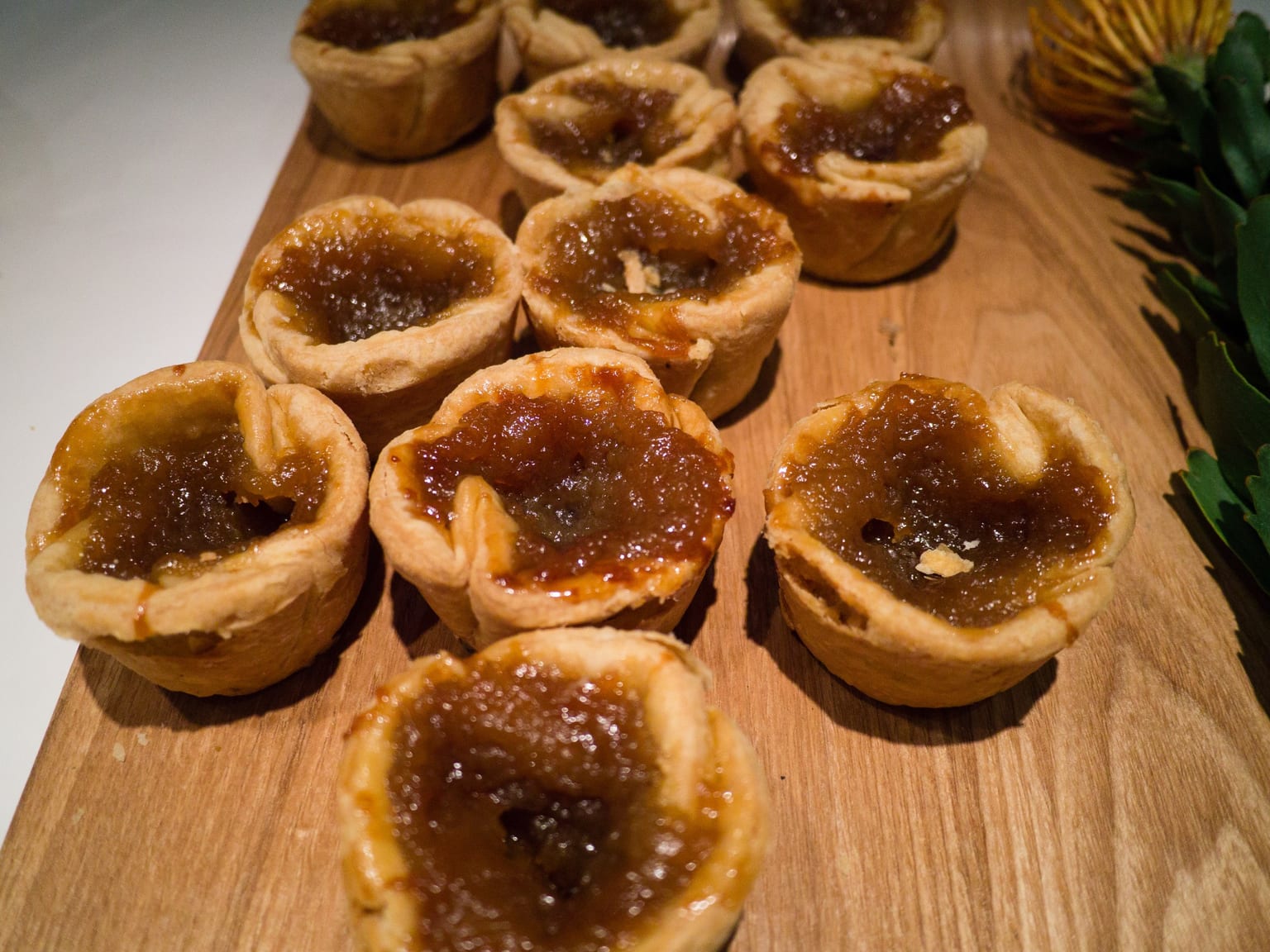
Butter tarts
The Ontario classic. Twelve short pastry shells filled with butter, dark brown sugar, syrup, and egg, baked hot on the bottom shelf until the filling is set at the edge and still loose in the middle. This version is runny on purpose, with the exact numbers for the firm camp in the notes.
Reconciled from Barry Parsons' Rock Recipes classic, Anna Olson's version with its vinegar trick, and the Chocolates and Chai recipe, which is the only one of the three that gives gram weights for the pastry. History and the runny versus firm and raisin arguments from Cottage Life and the Simcoe County Archives note on Mary MacLeod's 1900 recipe. German ingredient substitutions worked out from Elle Republic on flour types, Nutmeg and Pancakes on brown sugar and on Crisco versus Palmin, and Healthvale on corn syrup alternatives.
Ingredients
Written for a 7 cm round tin
Pastry
- 300 g plain flour rounded
- 6 g fine salt rounded
- 10 g granulated sugar rounded
- 115 g unsalted butter, very cold, diced rounded
- 60 g lard or vegetable shortening, cold, in small lumps rounded
- 90 ml ice water, hold back the last 15 ml rounded
- 5 ml white wine vinegar rounded
Filling
- 220 g dark brown sugar, firmly packed rounded
- 120 ml golden syrup or corn syrup rounded
- 85 g unsalted butter, melted and cooled rounded
- 2 eggs, size M, at room temperature rounded
- 10 ml white wine vinegar rounded
- 5 ml vanilla extract rounded
- 2 g fine salt rounded
- 90 g raisins, soaked 10 minutes in hot water, drained, and patted dry (optional) rounded
To finish
- 1 egg, beaten, for brushing the pastry rims (optional) rounded
Dietary labels are a guide, not a guarantee. If you have an allergy, read the ingredients yourself.
Method
- Rub or cut the cold butter and lard into the flour, salt, and sugar until the mixture holds pieces of fat from pea size down to coarse crumbs. Leave some pieces visible. Fully rubbed in fat makes short pastry, not flaky pastry, and you want flake here to stand up to the filling.
- Mix the vinegar into 75 ml of the ice water and add it in three goes, tossing with a fork after each. Squeeze a handful. If it holds without cracking, stop. Add the last 15 ml only if it will not hold. German flour takes less water than Canadian all purpose does, so expect to leave some behind.
- Press the dough into two flat discs, wrap, and chill at least 45 minutes. Cold dough is the whole game. Warm dough slumps down the muffin cup walls in the oven and the filling escapes underneath.
- Roll each disc to 3 mm and cut twelve 11 cm rounds, rerolling scraps once. Press each round into a muffin cup, working it into the corner so there is no air pocket at the base. Leave the top edge standing slightly proud of the tin. Chill the lined tin 20 minutes while you make the filling and heat the oven.
- Heat the oven to 220°C, conventional, with a rack on the lowest shelf. This is not the usual middle shelf. The bottom shelf is what sets the pastry base before the wet filling can soak into it.
- Whisk the brown sugar with the melted butter until there are no dry pockets, then whisk in the syrup, eggs, vinegar, vanilla, and salt. Whisk to combine and stop. Beating air into it makes the filling puff, dome, and then collapse into a crater.
- Drop the soaked raisins into the chilled shells, about 7 or 8 per tart. Ladle the filling over them to two thirds up the shell, no higher. It rises as it bakes and anything above two thirds boils over the rim and welds the tart to the tin. Brush the exposed pastry rims with beaten egg if you want them glossy.
- Bake 12 to 15 minutes on the lowest shelf. Start looking at 12. They are ready when the pastry rim is a proper mid brown, the filling is puffed and set for about 1 cm in from the edge, and the centre still wobbles as one piece when you nudge the tin. That wobble is the runny centre. Two minutes past that point and the whole surface goes matte, the wobble stops, and you have made a firm tart by accident.
- Cool in the tin on a rack for exactly 10 minutes, then run a thin knife around each tart and lift it out. Any longer and the sugar that crept underneath sets like glue. Any shorter and the pastry is too soft to take the weight.
- Cool completely on the rack, at least an hour. The filling keeps thickening as it cools; a tart cut hot will simply empty itself onto the plate.
Notes
- Runny or firm. This version is runny, and here is the exact swap. The argument in Canada is real and unwinnable; a Rock Recipes reader poll put it at roughly 60/40 for runny. Runny is the one I would serve, because a set filling is functionally a small pecan pie and you lose the thing that makes a butter tart worth eating over the sink. The formula above is 220 g brown sugar, 120 ml syrup, and 2 eggs to twelve shells. For a firm filling: add a third egg, raise the brown sugar to 260 g, drop the syrup to 80 ml, and whisk in 15 g of flour. Bake at 200°C rather than 220°C for 18 to 20 minutes, until the surface is matte all the way across and no longer moves. Do not simply bake the runny version longer; the sugar catches at the edge before the middle sets, and you get burnt and loose at the same time.
- Raisins or no raisins. This is a second, separate war and there is no correct answer. Raisins add chew and cut the sweetness; without them the tart is pure sugar, butter, and pastry. Pecans and walnuts are the usual third position, and toasted pecans are excellent. Chocolate chips are done and no one will stop you. Split the batch: six with, six without, which is what most Ontario kitchens do anyway. If you use raisins, soak them, because dry ones pull moisture out of the filling and go hard.
- Flour, Type 405 versus Type 550. These are not interchangeable in this recipe, and 405 is the wrong default. Canadian all purpose flour is milled from hard red spring wheat and runs about 13% protein, which is stronger than both American all purpose and anything on a German supermarket shelf. Type 550 is the closest German match for handling strength and is what to use: it gives you a shell with enough structure to be lifted out of the cup at 10 minutes without tearing. Type 405 is lower protein and closer to a pastry flour, so it bakes more tender but tears when you line the cups and splits under a boiling filling. If 550 is all that is in the cupboard, use it and expect to patch nothing. If 405 is all that is in the cupboard, chill the lined tin for 40 minutes instead of 20, and handle the shells like they will break, because they will. Either way, hold back 15 ml of the water: German flour absorbs less than the Canadian flour these recipes were written around.
- Brown sugar. German brauner Zucker is not American or Canadian brown sugar. Canadian brown sugar is refined white sugar with molasses added back, so it is fine, damp, sticky, and packs into a spoon. German brauner Zucker is partly refined cane sugar, coarse and dry, and it will not pack, will not dissolve as fast, and gives you a thinner, less caramel filling. Two workable answers. Best: buy dunkler Muscovado, sold in most German supermarkets and every Reformhaus, which matches Canadian dark brown sugar for moisture and flavour closely enough that nobody will notice. Cheapest: make it. Blend 500 g white sugar with 30 g Melasse or Zuckerrübensirup on low for a full 5 to 10 minutes until the colour is even and it clumps when you squeeze it. Weigh the finished sugar; do not measure it by volume, and ignore any recipe that says “packed cup”, which is why this one gives grams.
- Corn syrup. Not sold in German supermarkets and you do not need it. What corn syrup does here is stop the sugar crystallising and keep the filling glossy, and any invert or glucose syrup does the same job. Ranked for this recipe: Lyle’s Golden Syrup is the best swap, one for one, and the faint butterscotch note actually improves it. Heller Glukosesirup from the baking aisle or a Backshop is the most neutral and the closest technical match. Honey works one for one but you will taste it, which is fine if you want to. Zuckerrübensirup works but is aggressive; use half syrup and half honey or you get Grafschafter with pastry around it. Real maple syrup is the Canadian upgrade rather than a substitute, and it is thinner, so use 100 ml and add 10 g more brown sugar. In a German supermarket expect to pay roughly 8 to 12 euro for a 250 ml bottle of the dark Grade C sort, which is the grade you want for baking because the lighter grades disappear entirely under the brown sugar. Buy a litre from an importer if you bake with it often.
- Shortening. The traditional Ontario fat here is lard, and Germany makes this easy: Schweineschmalz from any Metzger or the refrigerated shelf is better than the Crisco most Canadian recipes call for, and it is what farm kitchens actually used. If you want it vegetarian, Palmin Soft is the closest German product to Crisco, and unlike Crisco it is not hydrogenated. All butter pastry also works and tastes better, but it is noticeably harder to line twelve cups with; if you go all butter, use 175 g total and add 10 minutes to every chill.
- Boiling over. The single most common failure. Three causes, in order: filled above two thirds, oven too low so the pastry sets after the filling starts to boil, or a shell with a crack or an air pocket at the base. Fill low, bake hot on the bottom shelf, and press the dough properly into the corner of each cup.
- History, briefly. The first published butter tart recipe is Mary MacLeod’s two line filling in the 1900 Women’s Auxiliary of the Royal Victoria Hospital cookbook from Barrie, Ontario. The origin beyond that is disputed, with claims for the filles du roi and for the Scottish border counties, and the culinary historian Liz Driver’s answer is more likely: farm kitchens with eggs, butter, brown sugar, and lard on hand invented it independently, the same way Quebec arrived at tarte au sucre.
- Keeping. Three days in a tin at room temperature, and they are better on day two. Do not refrigerate; the cold sets a runny filling and defeats the point. They freeze well for two months, wrapped individually, and defrost at room temperature in an hour.
Sources used
- Rock Recipes: The Best Classic Canadian Butter Tarts
- Anna Olson: Butter Tarts
- Chocolates and Chai: Canadian Butter Tarts, with gram weights
- Cottage Life: The surprisingly controversial story of the butter tart
- Simcoe County Archives: Mrs. Malcolm MacLeod and her recipe for butter tart filling, 1900
- Elle Republic: German vs American flour equivalents
- Nutmeg and Pancakes: Deutscher vs. amerikanischer brauner Zucker
- Nutmeg and Pancakes: Crisco vs. Palmin Soft
- Healthvale: Maissirup-Alternativen in Deutschland
Good with
From Christoph Mayer