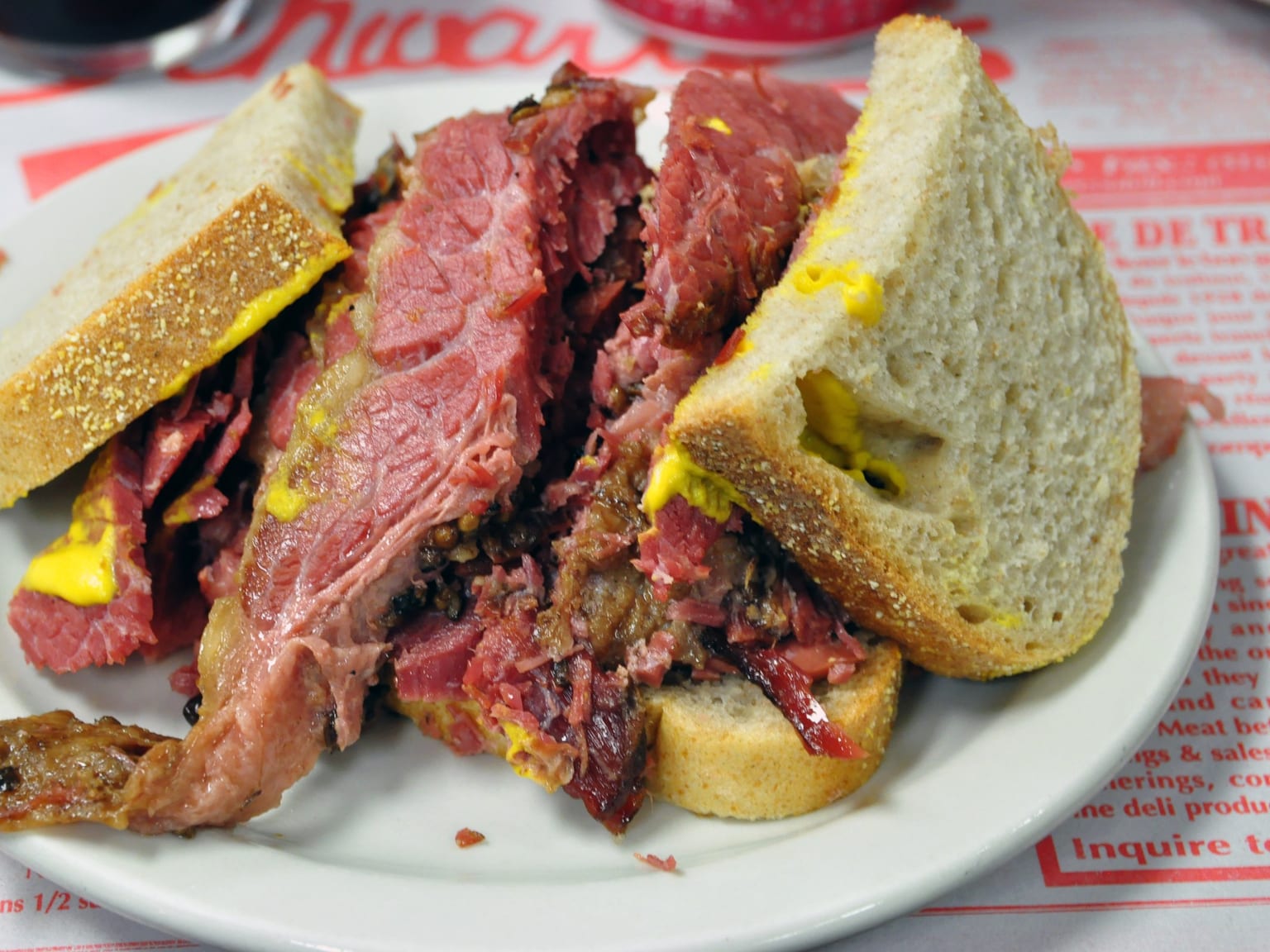

Montreal smoked meat
Beef brisket cured for eight days with curing salt, coriander, and black pepper, smoked over beech or cherry wood, and then steamed until a skewer slides through it without resistance. The steaming is the step that makes it Montreal smoked meat instead of a dry brisket. Sliced by hand onto rye with yellow mustard.
Built from the Meatwave, Glebe Kitchen, and Celebration Generation smoked meat recipes for the cure, rub, smoke, and steam timings, with the historical method and the whole-brisket point checked against the Tourisme Montréal guide. Curing chemistry reconciled from AmazingRibs on nitrite safety, charcuteria.de on Nitritpökelsalz strength and dosage, and Commission Regulation (EU) 2023/2108 for the current European nitrite limits. German cut terminology from Filetsteak.org, German dry cure quantities cross-checked against the BBQPit pastrami, and the Kugelgrill smoking method from Schamotte-Shop.
Ingredients
Written for a 20 L pot
Meat
- 2 1/2 kg beef brisket flat, in one piece, fat cap left on, not rolled and not tied rounded
Cure
- 50 g Nitritpökelsalz, 0.4 to 0.5% sodium nitrite, 20 g per kg of trimmed meat, weigh it, this is the only ingredient in the recipe that is a safety number rather than a taste decision rounded
- 25 g brown sugar rounded
- 20 g black pepper, coarsely ground rounded
- 15 g coriander seed, coarsely ground rounded
- 6 g garlic powder rounded
- 3 g ground bay leaf, about six dried leaves ground in a spice mill rounded
- 2 g yellow mustard seed, cracked rounded
- 1 g ground cloves, about a quarter teaspoon, measure it rounded
Rub and smoke
- 30 g black peppercorns, cracked coarse, gravel not powder rounded
- 25 g coriander seed, cracked coarse rounded
- 5 g garlic powder rounded
- 100 g smoking wood chunks, beech or cherry, soaked chips are the fallback, never conifer rounded
To serve
- 16 rye bread, light rye, cut thin, not a dense Vollkornbrot rounded
- to taste yellow mustard, the ballpark kind, not Dijon rounded
- to taste dill pickles rounded
Method
- Order the meat a week ahead. Ask the Metzger for Rinderbrust, Brustkern, am Stück, roughly 2.5 kg, with the fat cap left on and the piece neither rolled nor tied. German butchers normally break the brisket down into Suppenfleisch or roll it for a Rollbraten, so this needs notice.
- Trim the fat cap down to about 8 mm. Take off the hard, waxy surface fat and the silverskin on the lean side. Leave the fat inside the muscle alone. Now weigh the trimmed piece and write the number down.
- Work out the curing salt from that weight: 20 g of Nitritpökelsalz per kilogram of trimmed meat. For 2.5 kg that is 50 g. Weigh it on a scale that reads to the gram. Do not measure it by spoon and do not round up because it looks like a small pile.
- Mix the curing salt with the sugar, pepper, coriander, garlic powder, bay, mustard seed, and cloves. Rub the whole lot over every surface of the meat, working it into the seams and the cut ends. Every gram goes on the meat; none stays in the bowl.
- Seal the meat in a vacuum bag, or a double freezer bag with the air pressed out, and put it in the coldest part of the fridge at 2 to 5°C.
- Cure 8 days. The rule for other sizes is one day per centimetre of thickness plus three days, never less than six. Turn the bag over daily and massage it. Liquid draws out in the first 48 hours and pools in the bag; that liquid is the cure, so keep it in there and keep it moving over the meat.
- Check it before you go on. A cured piece is firm and springy right through, not soft in the middle, and a nick into a corner shows an even deep red-pink all the way in. Grey and soft in the centre means it needs two more days.
- Rinse under cold water for about 30 seconds and rub the spice paste off. Do not soak it. This is an equilibrium cure at 2% salt, so there is no excess to draw out; a three hour soak just washes flavour into the sink. Soaking belongs to the old barrel cures that ran at 6% salt or more.
- Pat dry and leave the meat uncovered on a rack in the fridge for 12 to 24 hours. The surface should go tacky and slightly dry to the touch. Smoke sticks to a tacky surface; on a wet one it beads and runs off, and the meat steams instead of smoking.
- Crack the pepper and coriander for the rub in a mortar, or under the flat of a heavy pan, or in a mill on its coarsest setting. You want gravel, not powder, because the coarse pieces are what build the crust. Mix in the garlic powder. No salt goes in the rub. Press the rub on hard, all over, until the meat is black with it.
- Set the smoker, kettle grill, or smoke oven up for indirect heat at 105 to 120°C. Put the meat on fat side up. Add the wood in the first two to three hours only. After that the meat has taken all the smoke it will take, and more wood on top of it turns the crust acrid.
- Smoke until the internal temperature at the thickest point is 74 to 77°C. For 2.5 kg that is 5 to 7 hours. Expect a stall somewhere around 65 to 70°C where the temperature sits still for an hour or more while the surface evaporates. Wait it out. Do not raise the heat and do not wrap it: wrapping now softens the crust, and the crust is half the dish.
- Now steam it. This is not a finishing touch and it is not optional. Everything up to here gives you a firm, well seasoned, smoky slab that is still tough. Set the meat on a rack over about 3 cm of simmering water in a large covered pot or a deep roasting tin, seal the lid with foil if it does not sit tight, and keep the water at a steady simmer so steam is always moving.
- Steam 2 to 3 hours. It is done at an internal temperature of 93 to 96°C, and more usefully, when a thin skewer pushed into the thickest part meets no resistance at all, the way it would going into butter left out on the counter. Lift a corner with tongs: the meat should sag and want to fold under its own weight. If it stands out stiff, give it another 45 minutes and test again. Undercooked, it is chewy and no amount of thin slicing rescues it. Overcooked, it falls apart on the knife, which is the smaller of the two problems, so aim past done rather than short of it. Top the water up with boiling water if the pot runs low.
- Rest 15 minutes in the pot with the heat off. Slice by hand across the grain at 4 to 5 mm, holding the knife at a slight angle, and pile the slices as they come off. Do not use a machine slicer; the meat is hot and loose and a slicer shreds it.
- Serve straight away on thin rye with yellow mustard, meat piled high, a pickle on the side. Nothing else belongs on it.
Notes
- Nitritpökelsalz is the reason this recipe is easier to make in Germany than in Canada, and it is also the one number you cannot get wrong. Curing salt in North America means Prague Powder #1, also sold as pink curing salt #1 or Insta Cure #1: 6.25% sodium nitrite in ordinary salt, dyed pink so nobody mistakes it for table salt. Most Canadians order it online. German Nitritpökelsalz (NPS) does the same job, is stocked by Metzgereien, Metzgereibedarf shops, Kaufland, and every online Wurstmacher shop, often sits on the supermarket shelf near the salt, and costs a few euros a kilo. It is 0.4 to 0.5% sodium nitrite, which is printed on the bag. Read your bag, because the two numbers are not interchangeable and the gap is enormous: NPS is roughly 13 times weaker than Prague Powder #1.
- The conversion, stated plainly. Never swap the two by weight. Prague Powder #1 is used at about 2.5 g per kg of meat, delivering roughly 156 mg of nitrite per kilogram. NPS is used as all of the salt in the cure, at 20 g per kg of meat, which delivers 80 mg of nitrite per kg with a 0.4% bag and 100 mg with a 0.5% bag. That is a proper cure and it sits at or just above the 80 mg per kg that Commission Regulation (EU) 2023/2108 has allowed commercial producers to add to non-heat-treated meat products since October 2025. Get it wrong in one direction and you have an uncured lump of meat sitting at fridge temperature for eight days, which is exactly the botulism risk the nitrite exists to remove. Get it wrong in the other direction, by using 50 g of Prague Powder #1 where this recipe says 50 g of NPS, and you put 3.1 g of sodium nitrite into 2.5 kg of meat, about 1250 mg per kilogram. A single sandwich then carries a few hundred milligrams of nitrite, which is a poisoning, not a seasoning error. This is why the curing salt in the ingredient list is set to scale linear and not seasoning: when you scale this recipe, the curing salt has to move in exact lockstep with the meat weight. It is not salt to taste.
- If you want it saltier, add plain salt, not more NPS. Schwartz’s meat is saltier than this. Twenty grams of NPS per kilo gives you 2% salt, which is well seasoned and lets the coriander through. If you want 2.5%, add 5 g of plain fine salt per kilo on top. The nitrite number stays where it is.
- The cut, and what to say to the Metzger. “Brisket” does not map cleanly onto German butchery. The German brisket is the Rinderbrust, and it splits into the Brustkern, the thick deep pectoral with the fat cap that Canadians would call the flat, and the Nachbrust, the thinner rear section. Querrippe is the cross rib above it and is not brisket, so do not accept it. Ask for Brustkern; it is the piece a German butcher would otherwise cure for Rinderbrust gepökelt anyway, so the request makes sense to him. If you want the whole packer with the point still attached, the words that work are “Full Packer Brisket” or Brustkern mit Brustspitze. Say explicitly that you do not want it rolled, tied, or trimmed of its fat cap.
- Montreal smoked meat against pastrami. Same idea, different execution. Pastrami in New York is traditionally the navel, a fattier plate cut, and its rub leans on coriander with paprika, mustard, and sometimes dill and celery seed. Montreal uses the brisket, which is why a Montreal sandwich comes in fat grades and a Schwartz’s order is placed as lean, medium, or fatty. The Montreal rub is stripped back: cracked black pepper and cracked coriander in roughly equal weight, garlic, and not much else. Every extra spice you add moves it toward pastrami. That is a real dish and worth making, it is just a different one, so I have kept the rub to three things.
- No smoker? Rank your options honestly. A charcoal kettle grill run indirect with a couple of beech or cherry chunks on the coals is the best route and most Germans already have one; hold 105 to 120°C with a small ring of briquettes lit at one end, vent open a crack, meat over the empty side. Second, a German Räucherofen or Räuchertonne, the kind sold for trout, works if you can hold it above 100°C, which most can. Third, a gas grill with a Räucherbox over one burner and the others off. Räucherchips and Räuchermehl in Buche, Erle, and Kirsche are two or three euros at any Baumarkt, which is another thing that is easier here than in Canada. Soak chips for half an hour so they smoulder; chunks go on dry. Never conifer.
- Oven and liquid smoke, and my honest verdict on it. You can cure the meat, cook it at 110°C in the oven to 75°C internal, and steam it exactly as written, and the result is genuinely good: pink, cured, peppery, tender, and worth eating. It is not Montreal smoked meat. It is closer to a spiced steamed corned beef. Liquid smoke does not fix this. Flüssigrauch is hard to buy in German shops and the flavour it gives is a flat, acrid phenol note that sits on the surface and tastes like an ashtray next to real smoke. If you are going to reach for something, use Rauchsalz, smoked sea salt, which is in every German supermarket: 5 g of it worked into the rub gives a mild smoke background without the chemical edge, and you should then drop the NPS by nothing at all, since Rauchsalz is a seasoning and the nitrite calculation is unchanged. My advice is to skip both and serve it unsmoked with no apology rather than serve it tasting of liquid smoke.
- Make ahead, which is how delis actually work. Nobody at Schwartz’s steams a brisket to order. Smoke it, cool it, wrap it whole and unsliced, and keep it up to five days in the fridge or three months in the freezer. Steam it back to life on the day: 45 to 60 minutes from chilled, 90 minutes from frozen, same doneness test with the skewer. Slicing it cold and reheating the slices dries them out, and a microwave turns it to leather. This also splits the work sensibly: cure in week one, smoke on a Saturday, serve whenever you like.
- What to eat it with in Germany. Thin light rye is right and easy here; a Roggenmischbrot cut thin works, a dense Vollkornbrot fights the meat. The yellow mustard is the mild American kind, not Dijon and not Löwensenf scharf, so a mittelscharfer gelber Senf is the closest thing on a German shelf. Gewürzgurken stand in for dill pickles exactly. Serve poutine alongside if you want the full thing, and yes, smoked meat poutine is a real order in Montréal, not a novelty.
- On the history, briefly. Smoked meat came to Montréal with Romanian and Eastern European Jewish immigrants in the late nineteenth century. Schwartz’s opened in 1928 and gets most of the credit, but the earlier claim runs to Aaron Sanft, a Romanian butcher who opened Montréal’s first kosher butcher shop in 1884. Who invented it is disputed and will stay disputed. What is not disputed is that the meat was originally dry cured in barrels for up to a month and smoked for the better part of a day, and that the modern version is quicker because of the nitrite.
Sources used
- The Meatwave: Montreal smoked meat
- Glebe Kitchen: Montreal smoked meat
- Celebration Generation: Authentic Montreal smoked meat
- Tourisme Montréal: Everything you should know about smoked meat
- AmazingRibs: The science of curing meats safely
- charcuteria.de: Nitritpökelsalz, was es ist und wofür du es brauchst
- Verordnung (EU) 2023/2108: Nitrite und Nitrate als Lebensmittelzusatzstoffe
- Filetsteak.org: Rinderbrust und Brisket, Brustkern, Nachbrust, Querrippe
- BBQPit: Pastrami selber machen, New York Style
- Schamotte-Shop: Räuchern im Kugelgrill
Good with
From Christoph Mayer