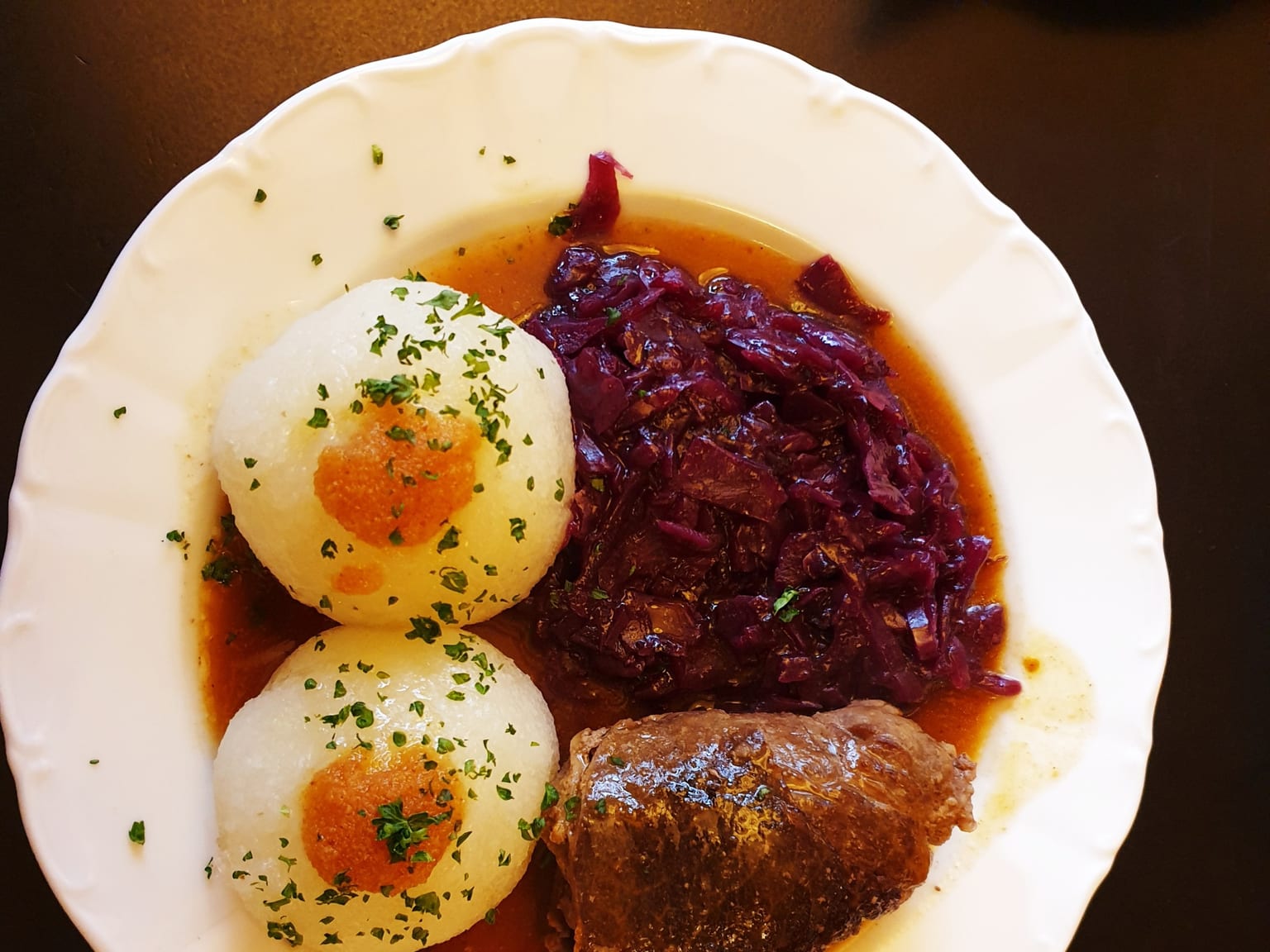

Rinderrouladen (German beef roulades)
Thin slices of beef spread with mustard, layered with bacon, onion, and pickle, rolled, browned, and braised slowly in red wine and beef stock. The Sunday dish of German home cooking.
Christoph's version, reconciled from three German home-cooking sources: emmikochteinfach, Maltes Kitchen, and Herdgeflüster, with the cut named the way a butcher will recognise it
Ingredients
Written for a 5 L pot
Units
Temperature
Servings
Rouladen
- 4 beef roulade slices, about 180 g each, pounded to 5 mm rounded
- 60 g medium-hot mustard rounded
- 8 streaky smoked bacon slices, two per roulade rounded
- 4 pickled gherkins, quartered lengthwise rounded
- 150 g yellow onion, cut into thin strips rounded
- to taste fine salt rounded
- to taste black pepper rounded
Braise and sauce
- 30 g clarified butter rounded
- 200 g yellow onions, roughly diced rounded
- 150 g carrots, diced rounded
- 100 g celeriac, diced rounded
- 100 g leek, white and light green only, sliced rounded
- 20 g tomato paste rounded
- 5 g sugar rounded
- 300 ml dry red wine, such as Spätburgunder or Lemberger rounded
- 500 ml beef stock rounded
- 2 bay leaves rounded
- 4 juniper berries (optional) rounded
- 15 g cornstarch, for thickening (optional) rounded
- 10 g flat-leaf parsley, chopped (optional) rounded
Dietary labels are a guide, not a guarantee. If you have an allergy, read the ingredients yourself.
Method
- Lay each slice of beef between two sheets of plastic and pound it to an even 5 mm. Even thickness matters more than thinness: a slice that is thick at one end cooks unevenly and tears when you roll it.
- Season the slices on the inside face with salt and pepper, then spread each with mustard right to the edges.
- Lay two slices of bacon down the length of each slice, scatter over the onion strips, and set a quartered gherkin along the short end nearest you.
- Fold in the long sides by a couple of centimetres, then roll up tightly from the filled end. Tie with kitchen twine in two places, or pin with Rouladennadeln. Season the outside with salt and pepper.
- Heat the clarified butter in the pot over high heat and brown the rouladen hard on all sides, in two batches if the pot is crowded. Browned meat is where the colour of the sauce comes from. Set them aside.
- Lower the heat to medium. Add the diced onions, carrots, celeriac, and leek and cook for about 8 minutes, until they take on colour. Stir in the tomato paste and the sugar and let them cook for 2 minutes, until the paste darkens and smells sweet rather than raw.
- Deglaze with a third of the red wine and let it reduce almost dry, scraping the bottom. Repeat twice more with the rest of the wine. Reducing in stages builds more flavour than pouring it all in at once.
- Heat the oven to 160°C. Return the rouladen and any juices to the pot, add the stock, bay, and juniper, and bring to a bare simmer. The liquid should come about two thirds up the rolls.
- Cover and braise in the oven for about 2 hours, turning the rouladen once, until a fork slides in with no resistance.
- Lift the rouladen out and keep them warm. Strain the sauce, pressing the vegetables firmly to get everything out of them, then return it to the pot and reduce until it coats a spoon. If it is still thin, whisk the cornstarch with a little cold water and stir it in, then simmer 2 minutes.
- Season the sauce with salt and pepper. Snip off the twine, return the rouladen to the sauce, and let them sit 10 minutes before serving. Finish with parsley.
Notes
- At a German Metzgerei, ask for Rouladen from the Oberschale and the butcher will cut and pound them for you. Unterschale or Schwanzstück also work and cost less. In Canada, ask for inside round cut for rouladen; most butchers know the term, and larger grocers sell it pre-labelled as rouladen. Top round or eye of round cut across the grain into 5 mm slices is the same thing.
- If your slices come home thicker than 5 mm, pound them yourself. This is the single step that decides whether the rouladen come out tender.
- Roll tightly. A loose roll lets the filling escape into the sauce and collapses on the plate. Two pieces of twine hold better than one.
- Keep the braise at a bare simmer. A hard boil tightens the meat and it will not come back.
- Rouladen are better the next day. Cool them in the sauce, refrigerate, and reheat gently on the stove. This is the main reason they are a Sunday dish: you can make them Saturday.
- Serve with Spätzle, Kartoffelklöße, or boiled potatoes, and something sharp on the side. Red cabbage is the standard.
- Bacon substitution: German durchwachsener Speck is closer to a lightly smoked side bacon than to Canadian back bacon. In Canada, use thick-cut streaky bacon and do not worry about the extra smoke.
Sources used
- emmikochteinfach: Klassische Rinderroulade
- Maltes Kitchen: Rinderrouladen Grundrezept
- Herdgeflüster: Rinderrouladen mit Rotweinsoße
Good with
Sources consulted
From Christoph Mayer