Breakfast French European Vegetarian Gluten-free
French omelette
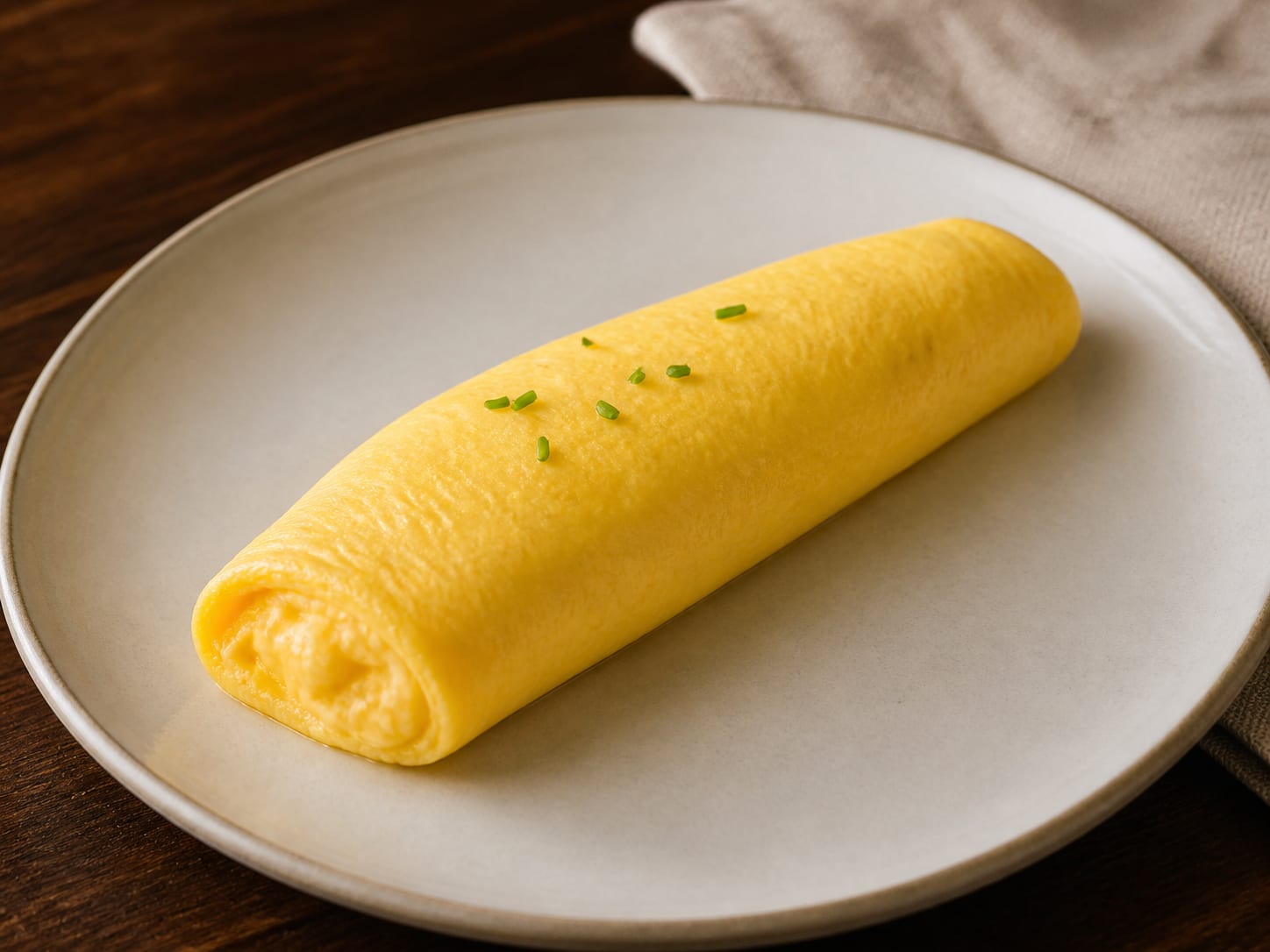
Three eggs, butter, chives, salt, and pepper become a pale, seamless omelette with fine curds and a softly set centre.
Prep5 min
Cook5 min
Servings1
Adapted for the home kitchen from Fallow's French omelette video
Ingredients
Written for a 20 cm pan
Units
Temperature
Servings
- 3 medium eggs rounded
- 30 g unsalted butter, divided rounded
- 5 g chives, finely sliced rounded
- 1 g fine salt rounded
- 0.5 g white or black pepper rounded
Dietary labels are a guide, not a guarantee. If you have an allergy, read the ingredients yourself.
Method
- Beat the eggs thoroughly with the salt until no separate whites remain; pass through a fine sieve if you want the smoothest finish.
- Heat a 20 cm nonstick pan over medium-low. Add 20 g butter and let it melt without browning.
- Add the eggs. Stir quickly with a silicone spatula while shaking the pan, scraping the base continuously to make very fine curds.
- When the eggs are mostly set but still glossy, stop stirring and smooth them into an even layer. Add pepper and most chives.
- Tilt the pan away from you. Fold the near third into the middle, then roll the omelette toward the far lip.
- Rub the remaining butter over the surface, turn seam-side down onto a warm plate, tuck the ends, and finish with chives.
Notes
- The pan must be warm enough to set eggs but not hot enough to colour butter. Pull it off the heat briefly if curds form faster than you can stir.
- A French omelette is softly set, not raw. People at higher risk from undercooked eggs should use pasteurised eggs or cook until fully set.
- Scale by cooking separate omelettes rather than crowding a larger pan.
Sources used
Sources consulted
Fallow states three medium eggs and demonstrates the butter-led technique; butter and seasoning amounts are normalized for a 20 cm pan.
From Christoph Mayer