
Side German European Vegan Vegetarian
Bauernbrot (German farmhouse bread)
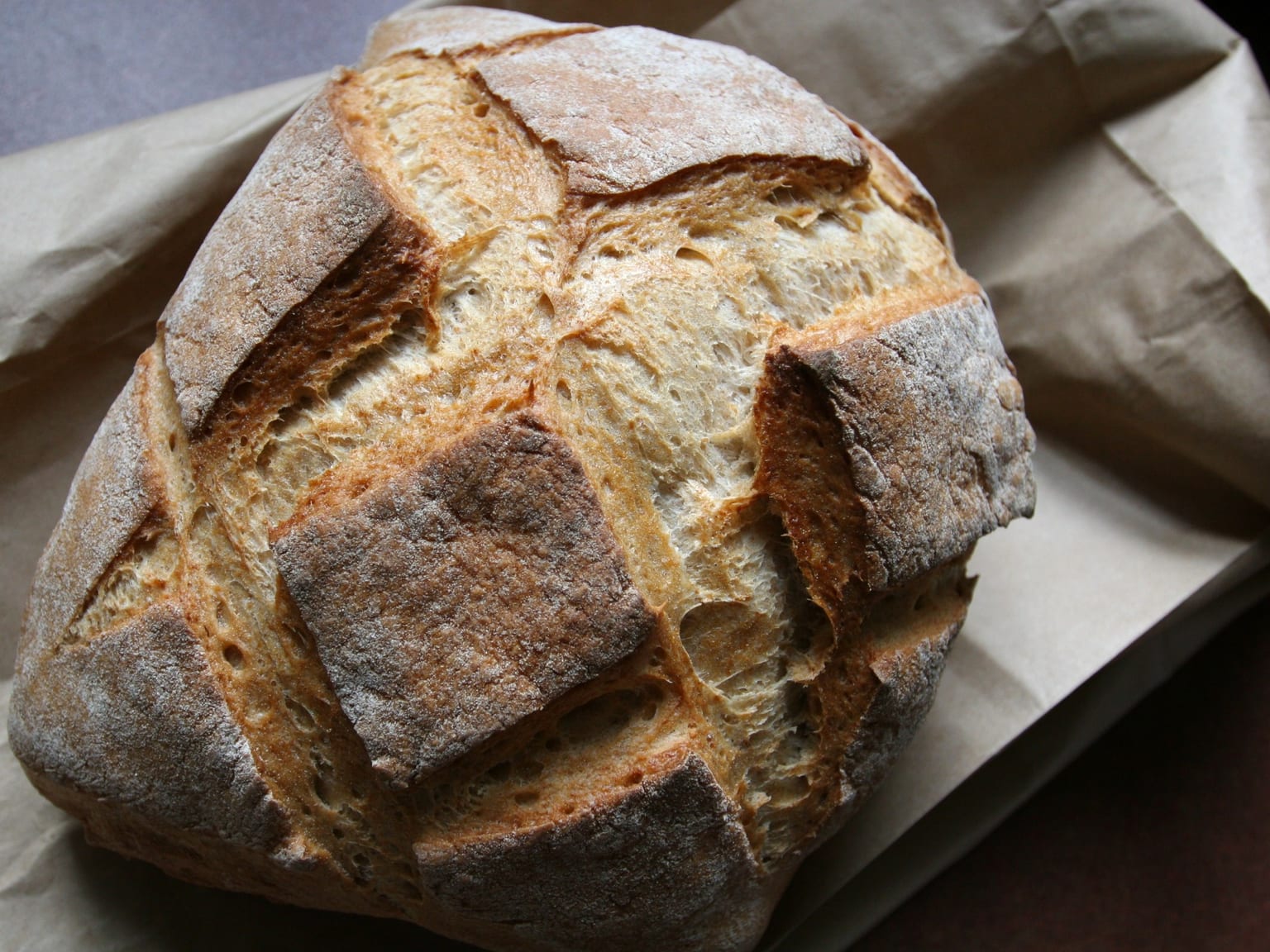
A German farmhouse loaf, seventy percent rye and thirty percent wheat, raised entirely on a rye sourdough. Thick dark crust, close moist crumb that keeps a week, and a sour that is doing structural work rather than decorating the flavour. It rests a full day before it is cut.
Reconciled from the Roggen-Weizen 70:30 Bauernbrot at Brotwein, the Roggenmischbrot mit Sauerteig at Backen macht glücklich, and the first Bauernbrot at Brooot.de, with the rye technique from Crumbs and Crust, the starter care from So nach Gefühl, and the reason rye has to be soured taken from the IREKS Kompendium der Bäckereitechnologie and Lutz Geißler's amylase entry on Plötzblog
Ingredients
Written for a 24 cm pot
Rye sourdough, built the night before
- 20 g rye sourdough starter, refreshed and active, see step 1 rounded
- 250 g dark rye flour rounded
- 250 ml water, at 40°C rounded
Main dough
- 310 g dark rye flour rounded
- 240 g strong wheat flour rounded
- 330 ml water, at 40°C rounded
- 17 g fine salt rounded
- 5 g fresh yeast, insurance only, leave it out if the starter is strong (optional) rounded
For the banneton
- 30 g dark rye flour, for dusting rounded
Dietary labels are a guide, not a guarantee. If you have an allergy, read the ingredients yourself.
Method
- Day 1, morning, about 08:00. Refresh the starter. If your Roggen-Anstellgut has been in the fridge more than a week, this is not optional, and the whole bake rests on it. Let the jar stand at room temperature for an hour, then stir 15 g of it into 50 g Roggenmehl 1150 and 50 ml water at 30°C. Cover loosely and leave 10 to 12 hours at 24 to 26°C. It is ready when it has roughly doubled, the top is domed and full of bubbles, and the dome has just stopped rising. A starter that has already sunk in the middle and smells of nail polish is past it: feed it again and bake tomorrow.
- Day 1, evening, about 20:00. Build the sourdough. Mix 20 g of the refreshed starter with the 250 g Roggenmehl 1150 and 250 ml water at 40°C. It will be a thick batter, not a dough. Cover and hold 14 to 16 hours at 26 to 28°C. An oven switched off with the light on is close enough; a cold kitchen at 19°C will take 20 hours and come out flat and sharp instead of sour and fruity. It is done when it has risen and just fallen back, the surface is honeycombed, and it smells sour, malty, and slightly of yoghurt.
- Day 2, about 10:00. Mix the main dough. Add the 310 g rye flour, 240 g wheat flour, 330 ml water at 40°C, the salt, and the yeast if you are using it. Mix 6 to 8 minutes on the slowest speed of a machine, or 4 minutes by hand with a sturdy spoon and a wet fist. You are mixing, not developing. There is no gluten network to build here, so longer kneading achieves nothing except warming the dough and tearing what structure there is. Target dough temperature 28 to 30°C, which is warmer than a wheat dough on purpose. The dough should look like thick, tacky mortar and fall off the spoon in sheets rather than strands.
- Cover and leave 45 to 60 minutes at room temperature. No stretch and fold, no coil folds. Those are wheat techniques and they do nothing to a rye dough but knock the gas out.
- Shape. Dust the bench heavily with rye flour. Wet your hands and a plastic scraper. Tip the dough out and push it in from the edges toward the middle with the scraper, turning the mass a quarter turn between pushes, six or eight pushes in all, until it is a rough round. Rye is pushed into shape, never stretched. Do not try to build surface tension, there is nothing to build it in, and pulling at it only tears the crumb. Roll the round once across the floured bench so it is coated, then drop it seam side up into a round banneton dusted hard with rye flour. Flatten the top gently with a wet hand.
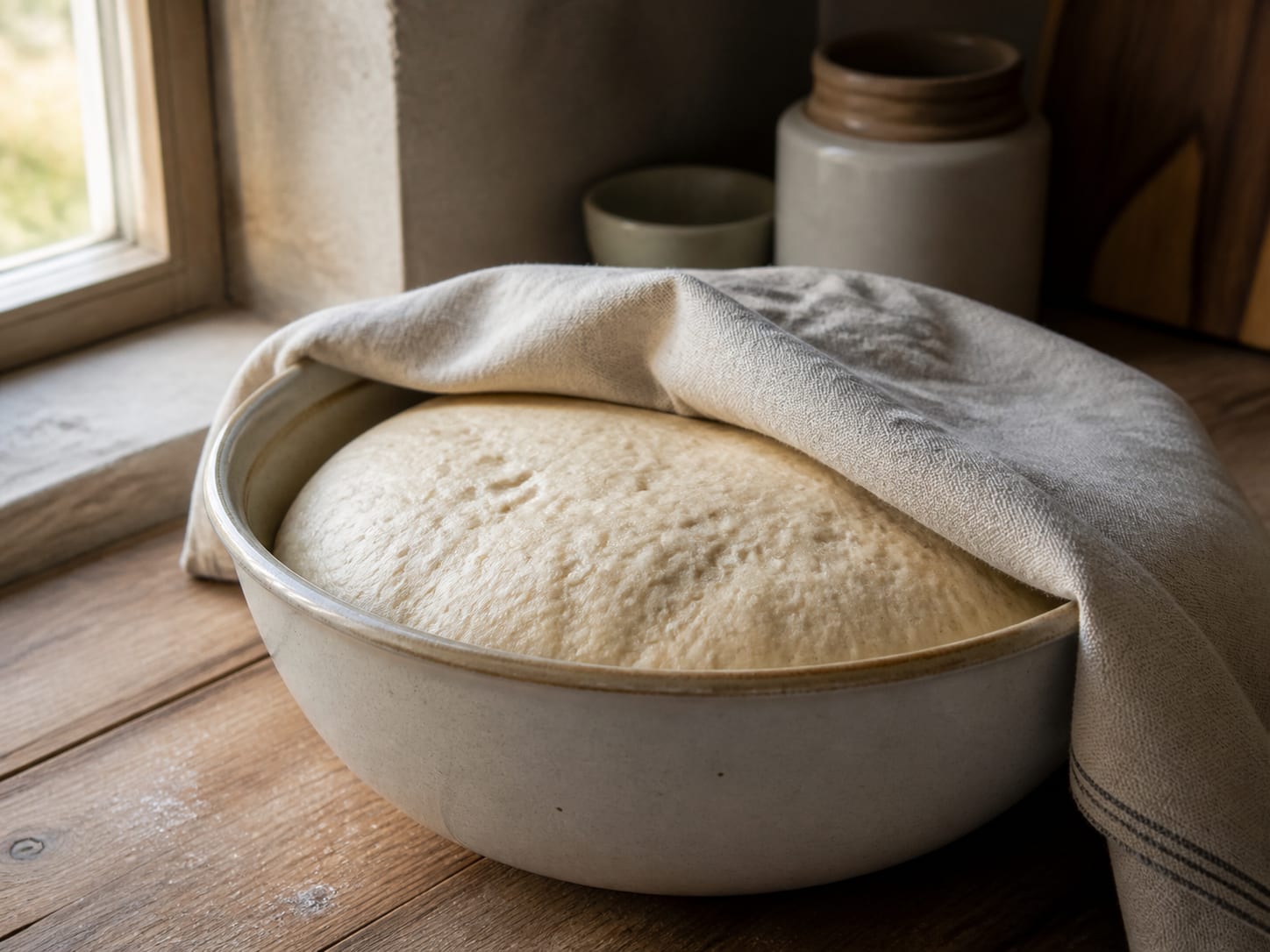
- Proof 60 to 90 minutes at room temperature. Judge it by looking, not by poking; the poke test tells you nothing about rye. It is ready when the surface has opened into a network of fine cracks and you can see bubbles in the cracks. Under-proofed, it tears violently open along one side in the oven and the loaf ends up lopsided. Over-proofed, it spreads flat and the crust lifts away from the crumb in a hollow shell, which German bakers call Krustenablösung.
- Meanwhile, put the cast iron pot with its lid into a cold oven and heat to 250°C. Once the oven reaches temperature, hold it another 20 minutes. Forty-five minutes total. The pot has to be genuinely saturated with heat, not just hot on the outside.
- Turn the loaf out onto a sheet of parchment, seam side up. Do not score it. The seam is your score. It will open across the top on its own and give a better burst than a blade does on a dough with no gluten to hold a clean cut.
- Lift the loaf on its parchment into the pot, lid on. Bake 15 minutes at 250°C. Reduce to 210°C and bake 15 minutes more with the lid on. Take the lid off, reduce to 200°C, and bake another 25 to 30 minutes.
- Done is 96 to 98°C in the centre on a probe, which is the only test worth trusting. Backing that up: the crust is deep brown, almost black in the ridges, hard enough to knock on, and it sounds hollow underneath. Rye wants a dark crust. Pull it while it is still tan and the bread tastes of nothing.
- Cool on a wire rack, on its side or standing up so air reaches the base.
- Wait 24 hours before you cut it. Wrap it in a linen cloth once it is fully cold, leave it on the counter, and cut it the next day. This is not a nicety.
Without a pot: heat a baking stone or steel to 250°C, slide the loaf on, and pour a cup of boiling water into a preheated tray on the oven floor. Let the steam out after 15 minutes, drop to 210°C for 15 minutes, then 200°C for the last 25 to 30. The crust is thinner and the loaf spreads more, but it works.
Notes
- Why rye is soured at all. This is the one piece of rye theory worth carrying around. Rye flour contains far more alpha-amylase than wheat, and rye starch gelatinises between about 53 and 73°C, which is precisely the temperature band where that enzyme is at its most active. So in the oven, in an unsoured rye dough, the enzyme meets freshly gelatinised starch, which is the form it breaks down fastest, and it eats the structure out of the loaf while it bakes. What you get is a wet, sticky, collapsed crumb, and often a crust that separates from it. Acid stops this: the amylase works best at pH 5.0 to 5.5, and sourdough drops the dough well below that, which shuts it down long enough for the starch to set. The same acid makes rye’s pentosans, the gums that hold rye dough together, swell and take up water properly. So the sour in a rye bread is load-bearing. The flavour is a by-product. This is also why you cannot make this loaf with yeast alone, and why a commercial acidifier will do the job in a pinch where extra yeast will not.
- Rye is not wheat and does not want to be handled like it. Rye has gliadin and glutenin but they will not form an elastic gluten network, because the pentosans get in the way. Everything that works on a wheat sourdough is either useless or harmful here: no autolyse worth doing, no windowpane test, no slap and fold, no stretch and fold, no tight boule with a taut skin, no long bulk. The dough is mixed only until even, given a short bulk, pushed into shape with wet hands and a scraper, and given most of its fermentation time in the banneton. It will be sticky and it will stay sticky. That is correct. Adding flour to make it feel like a wheat dough gives you a brick.
- The flour types, and what each one does. German flours are graded by ash content in milligrams per 100 g of dry flour, which is a measure of how much of the bran and outer endosperm survived milling. Roggenmehl Type 1150 is the standard rye bread flour: dark enough to carry real rye flavour and enzyme activity, light enough that the crumb is not heavy. Type 997 is a shade lighter and milder, and if that is what your mill sells, use it and expect a slightly softer, less assertive loaf. Weizenmehl Type 1050 is the wheat side: stronger and darker than the everyday Type 550, with enough protein to give the loaf some lift and enough of the grain left in it to taste of something. Type 550 works and gives a lighter, blander crumb. Type 405 is cake flour, do not use it here.
- Seventy percent rye, and what that changes. At 70 percent rye this is a Roggenmischbrot, a rye-led mixed bread. Legally in Germany, a Roggenmischbrot is over 50 percent rye and a Weizenmischbrot is over 50 percent wheat, and the difference is not academic. At 70 percent rye you get a dense close crumb with small even holes, deep flavour, and a loaf that stays moist for a week because the pentosans hold onto water. You also get a dough that cannot be handled like wheat at all, and a loaf that has to rest before cutting. Take it down to 50:50 or 30:70 and it becomes a Weizenmischbrot: more open, lighter, easier to shape, quicker to go stale, and you can score it properly. Take it up to 100 percent rye and you should bake it in a loaf tin, because there is nothing left to hold a free-standing shape.
- The 24 hour rest is the step people skip and then blame the recipe. A rye crumb sets as it cools, and the starch keeps taking up water for many hours after the loaf leaves the oven. Cut it warm, or even four hours out, and the crumb is gummy, it smears on the knife, the slices tear, and the loaf dries out fast because you opened it before the moisture had evened out. The same loaf cut the next morning slices cleanly and tastes better. Twenty-four hours from the oven is the rule for a 70 percent rye. Twelve is the absolute minimum and you will notice. This is the single most common reason someone decides they do not like homemade rye bread.
- Why a pot rather than a tin. A 24 cm cast iron pot with a lid does two things a tin does not. The lid traps the loaf’s own steam for the first 30 minutes, which keeps the surface flexible while the loaf expands and then sets it into a thick glossy crust. And the walls catch a slack rye dough that would otherwise spread on a flat stone, pushing the rise upward instead of outward. A round tin gives you a tidier, taller loaf and is a reasonable choice if you find the free-standing version spreads too much, but you trade away the burst across the top and most of the crust. Scaling here is a constraint, not a ratio: the pot fixes the loaf, so bake two loaves one after the other rather than trying to fit a double batch in.
- What a Canadian reader should buy. German type numbers do not exist in Canada, so buy by description. For Roggenmehl Type 1150, buy dark rye flour, sold by Bulk Barn, Arva Flour Mill, Speerville, and most Polish, Ukrainian, or German grocers. If all you can find is light rye, replace 50 g of the 560 g of rye with whole rye flour or rye meal to bring the bran level back up. Do not use pumpernickel meal for the whole quantity, it is coarse whole rye and will make a much heavier loaf. For Weizenmehl Type 1050 there is no direct equivalent: use 200 g Canadian all-purpose plus 40 g whole wheat, which lands close on both ash and colour. Note that Canadian all-purpose is milled from hard red spring wheat at around 13 percent protein against roughly 10.5 percent for German Type 550, so it is stronger than any German flour of a similar type number. At 30 percent of the blend that works in your favour here.
- Keeping the starter. Feed it 15 g starter to 50 g rye flour to 50 ml water at 30°C, leave it 12 hours at room temperature, then back in the fridge. Once a week is comfortable, and a well-established rye starter will survive two weeks. Always refresh it once before a bake even if it was fed recently, because fridge-cold starter is slow and a slow sourdough gives you an under-acidified dough, which is exactly the thing that ruins a rye crumb.
- The 5 g of yeast is insurance and nothing else. A vigorous starter does not need it. Leave it out on your second bake once you know how your starter behaves, and add 20 to 30 minutes to the final proof.
- Storage. Cut side down on a wooden board, or in a linen bread bag, at room temperature. Five to seven days, and it improves for the first two. Never in the fridge, which stales bread faster than the counter does. It freezes well cut into slices.
- What to do with it. Fresh, with butter and salt, or under Obatzda. Day three or four with Schwäbischer Wurstsalat. Once it goes properly stale it becomes the raw material for Semmelknödel and Ofenschlupfer, which are both better with a rye-heavy bread than with white rolls.
Sources used
- Brotwein: Bauernbrot, Roggen-Weizen-Mischbrot 70:30 mit Sauerteig
- Backen macht glücklich: Roggenmischbrot mit Sauerteig
- Brooot.de: Dein erstes Bauernbrot, ein einfaches Rezept
- Crumbs and Crust: Roggenbrote backen, Tipps für das Verarbeiten von Roggen
- Crumbs and Crust: Bauernbrot für Anfänger mit Sauerteig
- So nach Gefühl: Den Roggensauerteig als Anstellgut pflegen
- IREKS Kompendium der Bäckereitechnologie: Warum muss Roggenmehl versäuert werden?
- Plötzblog Bäckerlatein: Amylase
- Brooot.de: Brot klebt beim Anschneiden, woran kann das liegen?
- The Brot Box: Wheat Flour Types, German vs. American Flour
Good with
- Gaisburger Marsch
- Laugenbrezeln (German lye pretzels)
- Obatzda (Bavarian beer cheese spread)
- Ofenschlupfer (Swabian bread pudding)
- Schwäbischer Wurstsalat (Swabian sausage salad)
- Semmelknödel (German bread dumplings)
From Christoph Mayer