
Dessert German European Vegetarian
Ofenschlupfer (Swabian bread pudding)
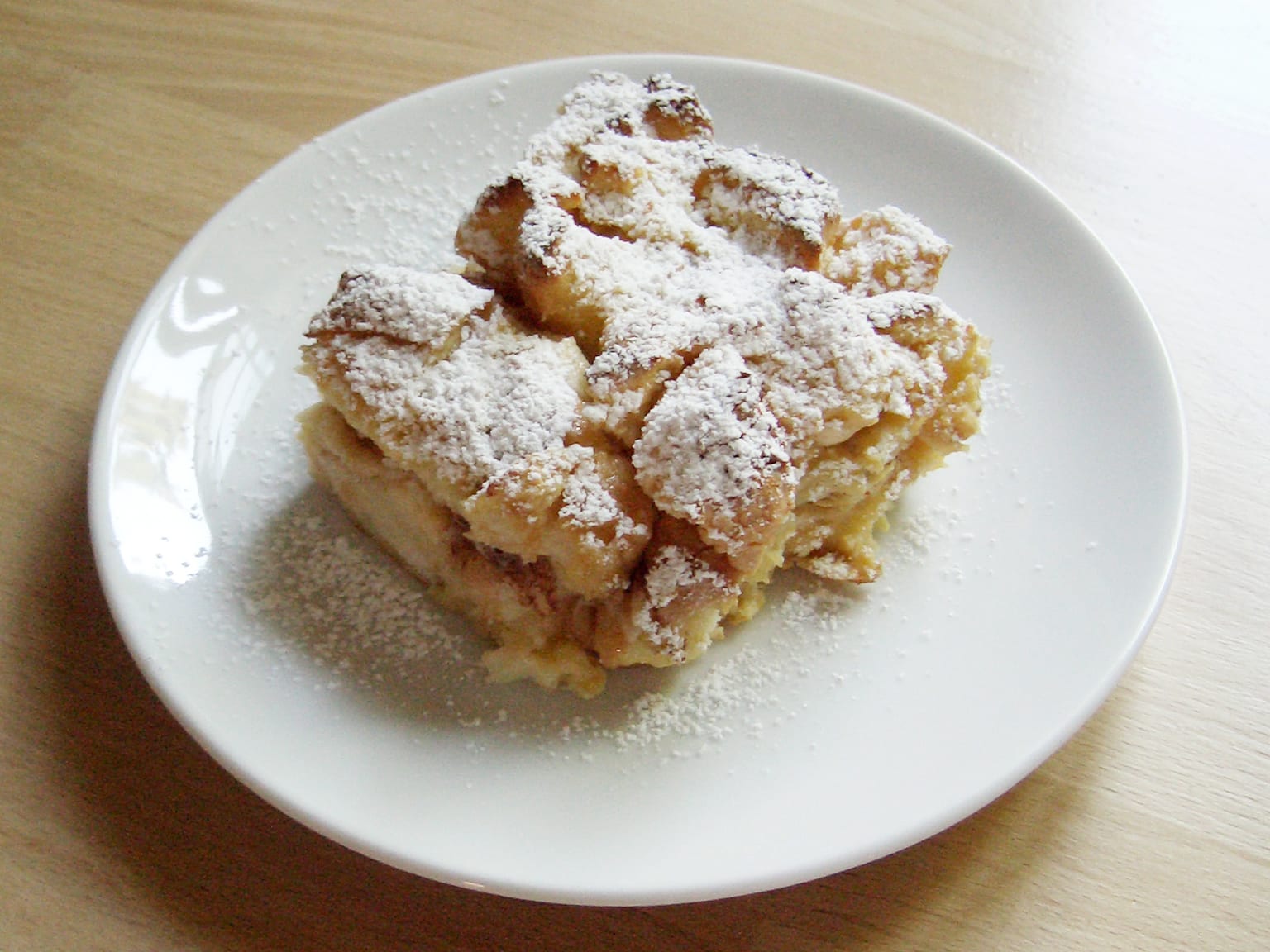
The Swabian baked bread and apple pudding. Stale Weckle soak up a vanilla custard between layers of tart apple, Kirschwasser raisins, and almonds, then bake until the top crisps. Served warm with Vanillesoße.
Written after reading four Swabian versions, from trickytine, Kochen macht glücklich, Albstadt Tourismus, and Schmeck den Süden, then settling on the custard ratio and the almond and Kirschwasser proportions myself.
Ingredients
Written for a 22 × 30 cm dish
Units
Temperature
Servings
The bake
- 300 g stale Weckle, about 6 rolls, sliced 1 cm thick rounded
- 500 g tart apples, peeled, cored, thinly sliced rounded
- 15 ml lemon juice rounded
- 80 g raisins, Zibeba in Swabian rounded
- 40 ml Kirschwasser, for soaking the raisins rounded
- 60 g sliced almonds rounded
- 400 ml whole milk rounded
- 150 ml cream rounded
- 4 eggs, size M rounded
- 80 g granulated sugar rounded
- 1 vanilla pod, seeds scraped out rounded
- 2 g ground cinnamon rounded
- to taste fine salt rounded
- 15 g butter, for the dish rounded
- 20 g butter, cold, in small flakes for the top rounded
- 20 g dry breadcrumbs, for a crisper top (optional) rounded
- to taste powdered sugar, for dusting (optional) rounded
Vanillesoße
- 350 ml whole milk rounded
- 150 ml cream rounded
- 1 vanilla pod, split lengthways rounded
- 40 g granulated sugar rounded
- 3 egg yolks rounded
- 8 g cornstarch rounded
- to taste fine salt rounded
Dietary labels are a guide, not a guarantee. If you have an allergy, read the ingredients yourself.
Method
- Put the raisins and the Kirschwasser in a small bowl and leave them at least 30 minutes. Overnight is better.
- Slice the Weckle about 1 cm thick. If they are only a day old and still springy, spread the slices on a rack for an hour or dry them for 10 minutes in a 100°C oven. Bread that is still soft collapses into paste under the custard.
- Heat the oven to 180°C. Butter the dish.
- Peel, quarter, and core the apples, slice them thin, and toss them with the lemon juice so they do not brown while you work.
- Whisk the milk, cream, eggs, sugar, vanilla seeds, cinnamon, and a pinch of salt until the sugar has dissolved.
- Layer the dish: bread, then apples, then a scattering of soaked raisins and almonds. Repeat, and finish with bread. For the classic look, stand the bread slices upright on edge in rows and push the apple slices between them, which gives more crisp surface on top.
- Pour the custard over evenly, press the bread down with a spatula so every slice is wet, and leave it 20 minutes. This soak is what separates Ofenschlupfer from a dish of bread sitting in scrambled egg.
- Scatter over the last of the raisins and almonds, then the breadcrumbs if you are using them, and dot the cold butter across the top.
- Bake 45 to 55 minutes, until the custard is set in the middle and the exposed bread is deep brown. If the top colours before the centre sets, lay a sheet of foil over it.
- While it bakes, make the Vanillesoße. Bring the milk, cream, and split vanilla pod to a bare simmer, then take the pan off the heat and leave it 10 minutes to infuse. Whisk the yolks with the sugar, cornstarch, and a pinch of salt. Pour a ladle of the hot milk into the yolks while whisking, return everything to the pan, and stir over low heat until it thickens enough to coat a spoon. Keep it under 80°C or the yolks will scramble. Fish out the pod.
- Rest the Ofenschlupfer 10 minutes so the custard firms, dust with powdered sugar, and serve warm with the sauce.
Notes
- Apples do the work here, so use a tart, firm variety that holds its shape: Boskop, Elstar, Jonagold, or Braeburn. A soft sweet apple turns to sauce and the whole thing goes wet.
- Weckle are the small white Swabian rolls, and stale ones are the point of the dish. In Canada, day-old crusty white dinner rolls work, and leftover challah or brioche makes a richer version. Sliced sandwich bread does not; it has no structure.
- Kirschwasser is what a Swabian kitchen reaches for and it carries further than rum. Dark rum is the common alternative. For a version children can eat, soak the raisins in warm apple juice instead and add a strip of lemon zest.
- Assemble it up to 12 hours ahead, cover, and refrigerate. Bake it straight from cold and add about 10 minutes.
- The Vanillesoße keeps two days. Press cling film onto the surface so it does not skin, and rewarm it gently while stirring. Do not let it boil at any point.
- Elsewhere in the German-speaking world the same idea turns up as Scheiterhaufen in Austria, Bavaria, and South Tyrol, and as Kirschenmichel in Baden and the Palatinate when it is made with cherries instead of apples. All of them started as a way to use up bread.
- Leftovers reheat well, covered, at 150°C for about 15 minutes. Cold from the fridge it is a perfectly good breakfast.
Sources used
- trickytine: Schwäbischer Ofenschlupfer mit Äpfeln und Vanillesoße
- Kochen macht glücklich: Ofenschlupfer mit Äpfeln
- Albstadt Tourismus: Ofenschlupfer, das schwäbische Original
- Schmeck den Süden: Echt schwäbisch, der Ofenschlupfer
From Christoph Mayer