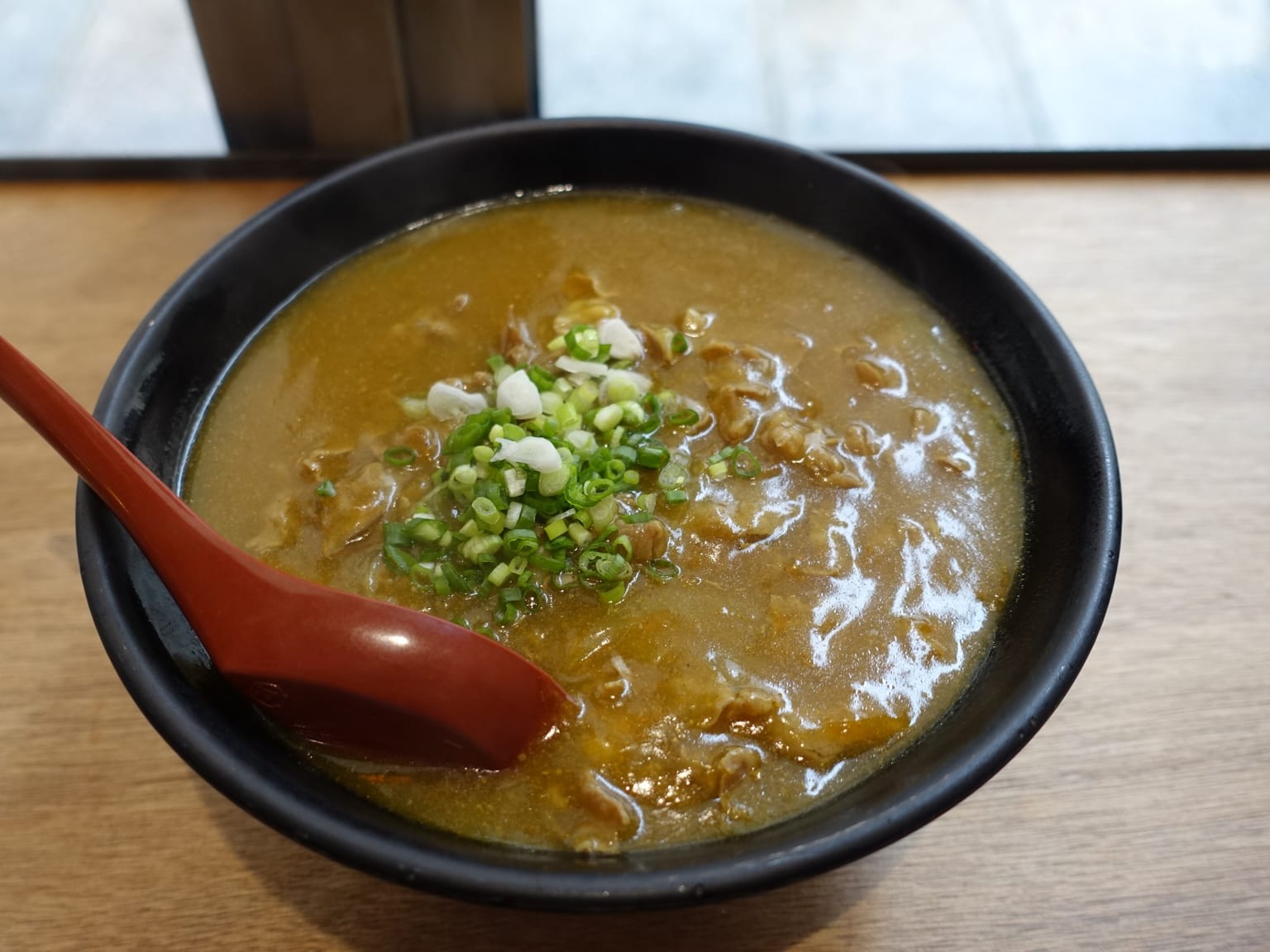

Curry udon
Kare udon (カレーうどん) is not curry poured over noodles. The broth is built on dashi, runs thinner than curry rice, and gets a potato starch slurry so it clings to the noodles instead of sliding off them. Thick frozen Sanuki udon, sliced pork, aburaage, and a soft egg.
Prep15 min
Cook25 min
Servings4
Adapted from Just One Cookbook's curry udon, Sudachi's curry udon and its curry powder plus starch slurry method, Japanese Cooking 101's two curry udon recipes, and No Recipes' curry udon, with dashi quantities cross-checked against Just One Cookbook and Sudachi's awase dashi
Ingredients
Written for a 4 L pot
Units
Temperature
Servings
Curry broth
- 1 1/6 L dashi, kombu and katsuobushi, or from a dashi packet rounded
- 60 ml soy sauce rounded
- 40 ml mirin rounded
- 8 g sugar rounded
- 28 g Japanese curry powder rounded
- 6 g garam masala, stirred in off the heat (optional) rounded
- 16 g potato starch, katakuriko, or cornflour at the same weight rounded
- 80 ml cold water, for the slurry rounded
Bowls
- 15 ml neutral oil rounded
- 300 g thinly sliced pork belly or shoulder, cut into bite-sized pieces, or use beef or chicken thigh rounded
- 200 g onion, sliced 1 cm thick rounded
- 2 aburaage, fried tofu pouches, rinsed with hot water and sliced (optional) rounded
- 800 g frozen Sanuki udon, 4 blocks, cooked from frozen rounded
- 4 spring onions, thinly sliced on the diagonal rounded
- 4 eggs, soft boiled 6.5 minutes, or slid in raw (optional) rounded
- to taste shichimi togarashi (optional) rounded
Method
- Make the dashi if you are making it from scratch: 10 g of kombu in 1.2 litres of cold water, brought slowly to just below a boil over about ten minutes, kombu lifted out before it boils, then 10 g of katsuobushi added, thirty seconds at a simmer, off the heat, ten minutes to settle, strained. Do not squeeze the flakes. A dashi packet simmered three minutes is a fair everyday substitute.
- Whisk the curry powder and the potato starch together into the cold water until it is smooth and about the thickness of pancake batter. Doing both powders in cold water at once is the trick that keeps the broth from going lumpy: dropped in dry, the curry powder floats and the starch sets on contact. Leave it beside the stove and whisk it again before it goes in, because starch settles fast.
- Heat the oil in a wide pot and cook the pork over medium-high heat until it has lost its raw colour and picked up a little browning. Add the onion and cook four or five minutes more, until it softens but keeps some structure. You want it to hold its shape in the bowl.
- Pour in the dashi, add the soy sauce, mirin, sugar, and the aburaage, and bring it to a simmer. Skim whatever grey foam rises. Simmer five minutes.
- Bring it down to a gentle simmer, barely moving. Whisk the slurry once more and pour it in slowly while stirring. Cook two to three minutes, stirring, until the broth turns glossy and thickens. Adding starch to a rolling boil sets it in lumps before it can disperse, which is the single most common way this dish goes wrong.
- Take the pot off the heat and stir in the garam masala. Taste and adjust the soy sauce. Keep it on the lowest heat while you deal with the noodles, stirring now and then, because a thickened broth insulates the bottom of the pot and will scorch.
- Cook the udon in a separate large pot of unsalted boiling water. Frozen Sanuki blocks take about one minute, just long enough to loosen and heat through. Drain them and rinse briefly under hot water to wash off the surface starch. Never boil the noodles in the curry: the starch they shed over-thickens the broth and turns it cloudy, and you lose control of the consistency you just set.
- Divide the noodles between four deep bowls, filling each bowl no more than half way. Ladle the broth over, then arrange the pork, aburaage, and egg on top and scatter over the spring onion. Shichimi at the table.
Notes
- Vegan rough-tofu bowl. Make kombu-shiitake dashi, omit the pork and egg, and use 500 g extra-firm tofu. Press it, or simmer it whole for 3 minutes in salted water instead (see the tofu prep formula), tear it by hand into rough bite-size pieces, dust lightly with starch, and brown it separately. Add it after the broth has thickened so the irregular faces absorb curry without turning soft. Check the curry powder and any Worcestershire-style seasoning for animal ingredients.
- The consistency, and why the starch is not optional. Curry rice sauce sits on rice and stays put. A noodle is smooth, wet, and moving, so a sauce of the same thickness slides straight off it into the bottom of the bowl. The starch is what makes the broth cling: you want it thin enough to drink from the bowl at the end and thick enough that lifting a noodle brings sauce up with it. Aim for something that coats a spoon in a thin even film and runs off in a sheet rather than in drops. If it is too thick, add hot dashi. If it is too thin, make a second slurry at a quarter strength and add it the same way, off the boil.
- Splatter, which is the real hazard. Curry udon is famous in Japan for ruining shirts, and shops hand out paper aprons with it. The physics is simple: a long thick noodle carrying a viscous coloured sauce, whipped upward at speed. Three things fix it. Fill the bowl half full, not to the brim, so there is nowhere for a flick to land. Do not slurp a full-length noodle; catch one with your chopsticks, fold it against the side of the bowl two or three times until it is a short compact bite, and lift it low and slowly. Keep a spoon under the chopsticks all the way to your mouth. Wear something dark, or an apron, and mean it. Cutting the noodles with scissors in the bowl works and is what you do for children, but it costs you the chew that is the whole reason for using Sanuki udon.
- The leftover curry route, which is the classic one. This dish exists because Japanese households have leftover curry. Take 250 ml of japanese-curry-sauce per person, thin it roughly one to one with dashi, add a splash of soy sauce, and simmer it for five minutes. Because that sauce is already roux-thickened, use half the slurry, 8 g of starch in 40 ml of water for four bowls, or skip it if the sauce clings well on its own. Skip the curry powder in the ingredient list entirely, since the sauce already has it. It is worth making the from-scratch version here at least once, because a broth built on dashi with soy and mirin tastes noticeably lighter and more clearly Japanese than diluted curry rice does.
- Buying udon in Germany. Frozen Sanuki udon is the right product and it is the only one worth the trip. Look in the freezer of any Asia-Markt for bags of five individually frozen blocks, usually 200 g or 220 g each, labelled 冷凍讃岐うどん or “frozen Sanuki udon”. Katokichi and TableMark are the reference brands, Shirakiku and Myojo are widely stocked and fine. Turn the bag over: the ingredient list should read wheat flour, water, and salt, and nothing else. Avoid the shelf-stable vacuum sachets sold with a soup powder sachet taped to them, which are soft, slightly sour, and slimy. Dried udon is a poor substitute here specifically: dehydration costs the noodle the elastic chew that defines Sanuki udon, and dried strands soften and break apart in a thickened broth in a way frozen ones do not. If dried is all you have, cook it two minutes short, rinse it hard, and accept that you are eating a different noodle.
- Dashi in Germany. Kombu and Katsuobushi (sold as Bonitoflocken) are Asia-Markt items and keep for years in the cupboard. Dashi packets, Dashi-Beutel, are the pragmatic weeknight answer and are genuinely good. Hondashi granules work at about a teaspoon per 500 ml, but they are salty, so cut the soy sauce back by a third if you use them. For a vegetarian version, use kombu with two or three dried shiitake soaked in the same water, drop the pork, and add fried tofu or mushrooms instead. Aburaage is in the Asia-Markt freezer as fried tofu pouches; the seasoned kind sold as inari-age also works if you cut the sugar in the broth.
- The toppings are standard, not decoration. Spring onion is not optional in practice, since the broth is rich and heavy and needs something sharp and raw on top. Aburaage soaks up broth and gives you a soft mouthful between the noodles. Thin sliced pork or beef is what a shop uses, sliced thin enough to cook in the broth in a minute, which is the Shabu-Shabu cut at the Asia-Markt or anything a German butcher will run through the slicer for you. A soft egg at six and a half minutes, halved on top, or a raw one slid into the hot broth to set as you eat it.
- Make ahead. The broth is better made in advance up to the end of step 5, then cooled and refrigerated for three days. It sets almost solid when cold, which is normal for a starch-thickened liquid; reheat it gently with a splash of dashi and it comes back. Do not freeze it. Starch-thickened broths break on thawing and go watery with a grainy edge, so freeze the curry sauce instead and build the broth fresh. Cook the noodles at the last minute always, never in advance.
- Failure modes. Lumps mean the slurry went into a boil rather than a simmer, or went in dry. Cloudy, gluey broth means the noodles were cooked in the pot. A broth that thickens and then thins again as it sits has been boiled hard after the starch went in, which breaks the starch chains and cannot be undone except by adding a fresh slurry. And a curry udon that tastes flat usually needs soy sauce, not more curry powder.
Sources used
- Just One Cookbook: Curry Udon
- Sudachi Recipes: Japanese Curry Udon
- Japanese Cooking 101: Curry Udon
- Japanese Cooking 101: Curry Udon with leftover Japanese curry
- No Recipes: Curry Udon from Scratch
- Just One Cookbook: How to Make Dashi
- Sudachi Recipes: Kombu and Bonito Awase Dashi
- Goodie Foodie Japan: How to eat curry udon without splashing
Good with
- Chicken katsu
- Japanese curry sauce
- Katsu curry
- Quick sesame cucumber salad
- Spinach gomae
- Tofu, prepped for flavour
Sources consulted
From Christoph Mayer