
Dessert German European Vegetarian Nut-free
Dampfnudeln (German steamed dumplings)
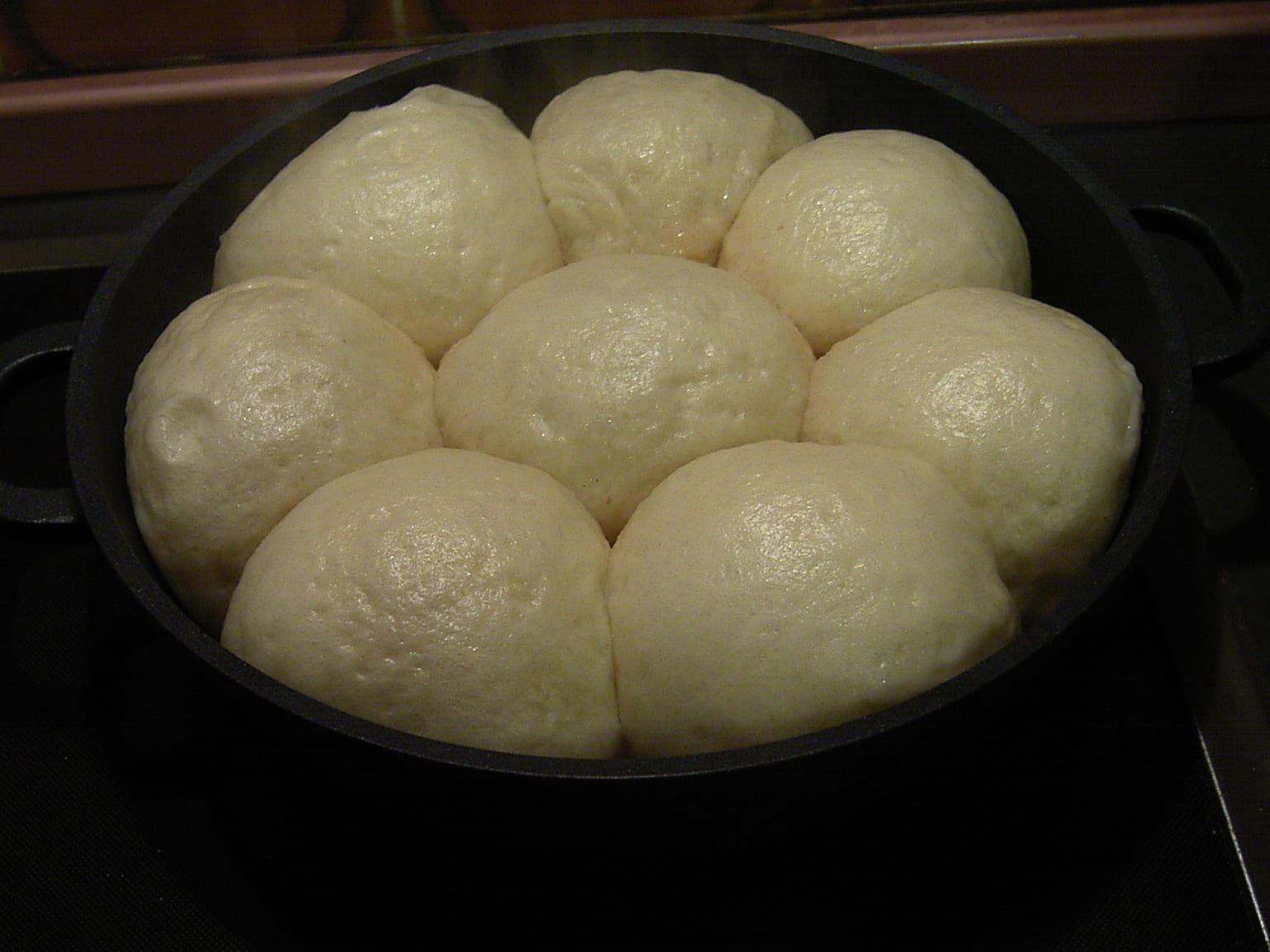
Yeast dumplings steamed in a covered pan with milk, butter, and sugar until the liquid boils away and the bottoms caramelise into a crisp golden crust. Sweet Bavarian version, served warm with Vanillesoße.
Built from five German versions, from Küchengötter, Unsere Bayerischen Bauern, Möey's Kitchen, Einfach Kochen, and the salt-crust method at Cookie und Co, then reconciled into one dough and one pan quantity that actually fits a 28 cm skillet.
Ingredients
Written for a 28 cm pan
Units
Temperature
Servings
Yeast dough
- 500 g strong plain flour rounded
- 250 ml whole milk, lukewarm rounded
- 21 g fresh yeast, half a cube, or 7 g instant dry yeast rounded
- 60 g granulated sugar rounded
- 70 g butter, soft rounded
- 1 egg, size M, at room temperature rounded
- 5 g fine salt rounded
- 1 lemon, zest only (optional) rounded
For steaming
- 200 ml whole milk rounded
- 50 g butter rounded
- 40 g granulated sugar rounded
- 1 g fine salt rounded
Vanillesoße
- 350 ml whole milk rounded
- 150 ml cream rounded
- 1 vanilla pod, split lengthways rounded
- 40 g granulated sugar rounded
- 3 egg yolks rounded
- 8 g cornstarch rounded
- to taste fine salt rounded
Dietary labels are a guide, not a guarantee. If you have an allergy, read the ingredients yourself.
Method
- Crumble the yeast into the lukewarm milk with a tablespoon of the sugar and leave it 10 minutes until it foams. Milk hotter than about 40°C kills the yeast, so test it on your wrist.
- Put the flour, remaining sugar, salt, and lemon zest in a bowl. Add the yeast milk, the egg, and the soft butter. Knead 8 to 10 minutes, by machine or by hand, until the dough is smooth, glossy, and pulls away from the bowl. It stays soft and slightly tacky. Do not fix that with more flour or the dumplings turn heavy.
- Cover and let it rise in a warm place 45 to 60 minutes, until doubled.
- Knock it back and divide it into 8 pieces of about 100 g. Shape each into a tight ball by rolling it under a cupped hand on an unfloured surface, which gives the surface tension the dumplings need to rise upward instead of spreading. Set them on a floured board, cover, and prove 25 to 30 minutes.
- In a 28 cm skillet or wide sauté pan with a tight lid, warm the milk, butter, sugar, and salt until the butter has melted. Take it off the heat.
- Place the dumplings in the pan with at least 2 cm between them and 2 cm to the wall. They roughly double in the pan. Eight balls of 100 g is the limit for 28 cm. If yours are crowded, cook them in two rounds with fresh liquid each time rather than squeezing them in, because dumplings that touch stay raw and pale where they meet.
- Cover, bring to a boil over medium-high heat for 1 to 2 minutes, then drop to medium-low. Steam 30 minutes. Do not lift the lid. The temperature drop collapses the dumplings and they do not come back. A glass lid is worth having for exactly this.
- Meanwhile make the Vanillesoße. Bring the milk, cream, and split vanilla pod to a bare simmer, then take it off the heat for 10 minutes to infuse. Whisk the yolks with the sugar, cornstarch, and a pinch of salt, temper in a ladle of the hot milk, return it all to the pan, and stir over low heat until it coats a spoon. Keep it below 80°C. Remove the pod.
- When you hear the liquid stop bubbling and start to crackle and hiss, the milk has gone and the sugar and butter are caramelising. Give it 2 to 3 more minutes with the lid on, then lift the lid away sideways so the condensation does not drip onto the tops.
- Loosen the crust with a thin spatula and serve straight away, crust side up or down as you like, with the warm Vanillesoße.
Notes
- The crust is the whole reason to make these. It comes from the liquid boiling off completely and the sugar and butter frying the bottoms for the last few minutes. Too much liquid and you get pale steamed buns; too little and they burn before they are cooked through. Roughly 200 ml in a 28 cm pan is the working ratio.
- The Bavarian salt-crust version is the same dough with the sugar cut to about 20 g, steamed in 125 ml water with 20 g butter and half a teaspoon of salt instead of the milk mixture. It gives a savoury, deeply browned crust. That version is really at home in the Palatinate, where salzige Dampfnudeln are eaten with potato soup or a wine sauce, and it is also common in Lower Bavaria. Sweet with Vanillesoße is the version I lead with here, and it is what you get in most Bavarian and Swabian Gasthäuser.
- Dampfnudeln are a main course as often as a dessert in southern Germany. Two per person with vanilla sauce, plums, or stewed apple makes lunch.
- Fresh yeast is sold in every German supermarket in 42 g cubes. In Canada, use 7 g of instant dry yeast, mixed straight into the flour rather than proofed in the milk.
- The dough can rise slowly in the fridge overnight. Shape the balls cold, then give them 45 minutes at room temperature before they go in the pan.
- They do not keep. Reheated Dampfnudeln lose the crust. If you must, cook the second round while the first is being eaten.
- A cast iron or heavy stainless pan holds heat more evenly than thin aluminium and gives a better crust. Nonstick works but browns less.
Sources used
- Küchengötter: Dampfnudeln mit Krusterl
- Unsere Bayerischen Bauern: Dampfnudeln
- Möey’s Kitchen: Dampfnudeln mit Vanillesauce
- Einfach Kochen: Dampfnudeln mit Vanillesoße nach Omas Rezept
- Cookie und Co: Salzige Dampfnudeln mit Salzkruste
From Christoph Mayer