
Dessert German European Vegetarian
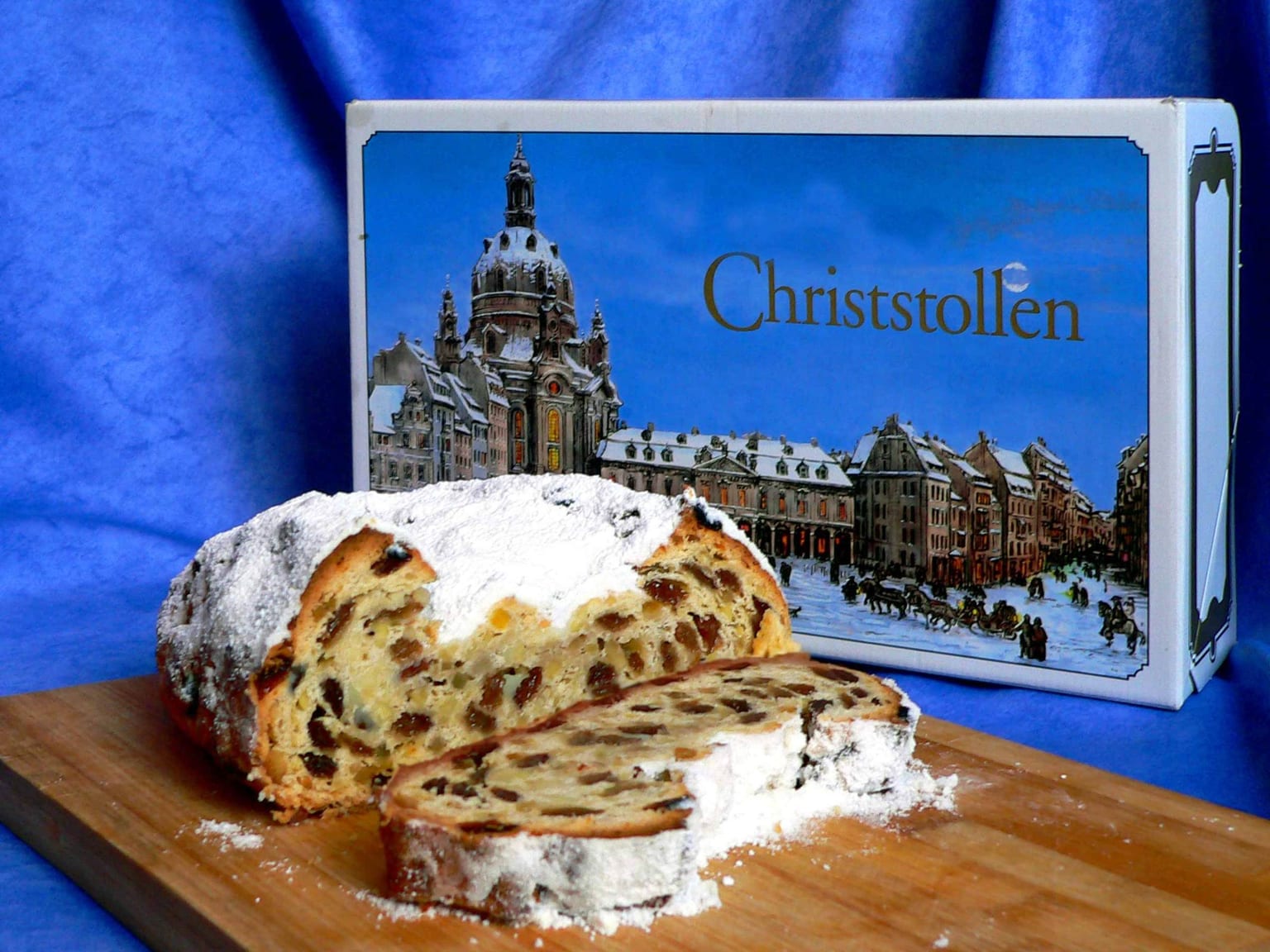
Christstollen (German Christmas stollen)
A Dresden-style yeasted Christmas loaf, heavy with butter, rum-soaked sultanas, candied peel, and almonds, baked free-form, then soaked in butter and buried in sugar while it is still hot. The coating is what preserves it. The four weeks of ageing are what make it worth eating.
Proportions set against the Dresdner Christstollen protected geographical indication rules as given in the German Wikipedia entry on Stollen and the Schutzverband Dresdner Stollen, with the working method reconciled from the Lecker Dresdner Stollen recipe, Maria es schmeckt mir, and Nicoles Zuckerwerk for the marzipan version
Ingredients
Written for a 40 × 35 cm baking sheet
Fruit, soaked the day before
- 325 g sultanas, or a mix of sultanas and raisins rounded
- 60 g candied citron peel, finely chopped rounded
- 60 g candied orange peel, finely chopped rounded
- 60 ml dark rum, 54% Stroh or a decent Jamaican rum, apple juice if you must rounded
Dough
- 500 g strong plain flour rounded
- 30 g fresh yeast, or 10 g dried yeast rounded
- 125 ml whole milk, lukewarm, about 30°C rounded
- 100 g granulated sugar rounded
- 8 g fine salt rounded
- 250 g butter, soft, not melted rounded
- 100 g ground blanched almonds rounded
- 1 unwaxed lemon, zest only rounded
- 2 g ground mace, nutmeg if you cannot get mace rounded
- 2 g ground cardamom rounded
- 8 g vanilla sugar, one sachet, Bourbon if possible rounded
- 3 bitter almond flavouring, drops (optional) rounded
Marzipan core, optional
- 200 g marzipan paste, the unsweetened baking kind, not shop marzipan (optional) rounded
- 30 g powdered sugar, kneaded into the marzipan (optional) rounded
Butter and sugar coating
- 100 g butter, melted, or clarified butter, which keeps longer rounded
- 60 g granulated sugar, fine caster if you have it rounded
- 120 g powdered sugar, for a thick final coat and a second dusting before serving rounded
Dietary labels are a guide, not a guarantee. If you have an allergy, read the ingredients yourself.
Method
- The day before, or up to a week before, put the sultanas, Zitronat, and Orangeat in a jar with the rum, seal it, and shake it. Shake it again whenever you walk past. The fruit should be plump and the rum almost all absorbed by the time you bake.
- Crumble the fresh yeast into the lukewarm milk with 20 g of the sugar taken from the dough total and 150 g of the flour taken from the dough total. Stir to a thick batter, cover, and leave 45 to 60 minutes until it is domed and full of bubbles. If you are using dried yeast, stir it into the warm milk with the sugar and give it 15 minutes before adding the flour.
- Put the remaining flour, remaining sugar, salt, ground almonds, lemon zest, mace, cardamom, vanilla sugar, and almond flavouring in a large bowl. Add the pre-ferment and the soft butter.
- Mix and then knead 8 to 10 minutes. This is a heavy, greasy dough and it will look wrong for the first five minutes. Keep going. It comes together into something smooth, dense, and slightly shiny that does not stretch into a windowpane and is not supposed to. In a stand mixer use the dough hook on low; the fat load will strain a small machine on high.
- Drain the fruit and keep any rum that has not been absorbed. Knead the fruit in by hand, in two or three additions, only until it is evenly spread. Overworking now tears the raisins and streaks the dough grey.
- Cover and prove 90 minutes to 2 hours at room temperature. It will rise slowly and will not double. All that butter suppresses the yeast, which is why the recipe uses 30 g of fresh yeast for 500 g of flour rather than the 15 g a plain dough would take.
- Knock it back gently and shape. Pat the dough on a floured surface into an oval about 30 by 20 cm. Press a lengthways trough down the middle with the side of a rolling pin, slightly off centre. Fold the smaller side over the larger so the top edge sits back from the bottom edge, then press along the fold line so it holds. That offset ridge is the Stollen shape and it is the only shaping this loaf gets.
- For the marzipan version, knead the powdered sugar into the marzipan paste, roll it into a rope 28 cm long, lay it in the trough before folding, and fold the dough over it.
- Lift onto a parchment-lined sheet pan. Prove another 30 minutes, uncovered. Meanwhile heat the oven to 200°C top and bottom heat.
- Put the Stollen in and immediately drop the oven to 175°C. Bake 55 to 65 minutes. Tent it loosely with foil once the top is a deep golden brown, usually around 30 minutes. It is done at a core temperature of 88 to 91°C, or when a skewer pushed into the thickest part comes out clean and dry.
- Have the melted butter, the granulated sugar, and a brush ready before it comes out, because the next step happens hot.
- Take it out and brush the whole loaf, top, sides, and ends, with about half the melted butter. Wait two minutes for it to soak in and brush on the rest. Then scatter the granulated sugar over the whole surface while it is still hot enough to melt slightly and cling.
- Cool completely on a rack, at least 4 hours. Then sift about 80 g of the powdered sugar over it in a thick, opaque layer. Do not be shy; the sugar is part of the seal, not a garnish.
- Wrap in baking parchment, then in aluminium foil, and store somewhere cool and dark at about 12 to 15°C. A cold pantry or an unheated room is ideal; a modern fridge is too damp.
- Leave it at least three weeks. Before serving, dust with the remaining powdered sugar. Cut from the middle outwards and press the two halves back together after each session, which keeps the cut faces from drying.
Notes
- Bake it on a sheet pan, free-form, not in a tin. A Stollen is shaped by that folded ridge, and it needs dry heat on all sides to build the firm crust that the butter and sugar coating then seals. In a loaf tin the sides steam, the crust stays pale and soft, the coating has nothing to grip, and the fat pools at the bottom. This is also why the Dresdner Christstollen rules prohibit baking in a mould outright. There are Stollen tins on the market; they make a nice-looking fruit loaf and not a Stollen.
- The butter and sugar coating applied hot is the whole preservation system, and it is the step people rush. A Stollen straight from the oven has an open, thirsty crust. It will absorb 100 g of melted butter in about five minutes, and that butter penetrates 3 to 4 mm and then sets as the loaf cools into a fat barrier that keeps the crumb’s moisture in and the air out. The sugar goes on top of it and pulls in the last of the surface moisture, drying the outside to a hard, dense shell. Together they are why a Stollen keeps for months without a preservative, which is the same reason it works as a Christmas gift you post. Do it cold and none of it happens: the butter sits on top and goes rancid on the surface, the sugar stays loose and falls off, and the loaf goes stale in a fortnight. Clarified butter, Butterschmalz, keeps longer than whole butter because the milk solids are gone, and it is what most Dresden bakers use.
- The ageing is not optional and it is not tradition for its own sake. Fresh from the oven a Stollen tastes of yeast and raw flour, the crumb is dry and crumbly, and the rum sits separate from everything else. Over three to four weeks the fat migrates out of the butter shell and back through the crumb, the moisture from the fruit spreads into the flour, and the spices, rum, and almond flatten out into one flavour. The texture goes from dry and cakey to dense and moist. There is no shortcut for this.
- A real timeline. Bake between the middle of November and the first Sunday in Advent. Wrap and store cool. Start eating from around the 15th of December at the earliest, which is three weeks after a mid-November bake. It peaks at about four to six weeks and holds there for another month. It will still be good in February. If you have left it until the second week of December, bake anyway and eat it at New Year rather than Christmas Eve; two weeks is the shortest rest that gets you most of the way, and one week is a waste of 250 g of butter.
- Dresdner Christstollen is a protected geographical indication in the EU register, which means the name belongs to bakers in Dresden and twelve surrounding municipalities and to nobody else. The Schutzverband Dresdner Stollen enforces the recipe rules and issues the gold oval seal, each one carrying a six-digit control number that identifies the bakery. The rules set minimums per 100 parts flour: at least 50 parts butter, at least 65 parts sultanas, at least 20 parts Orangeat and Zitronat together, and at least 15 parts almonds. Margarine is banned, artificial flavourings and preservatives are banned, and it may not be baked in a mould. The Leitsätze für Feine Backwaren set lower bars for the generic terms: plain Stollen needs 30 parts fat and 60 parts fruit, and Butterstollen needs 40 parts butter and 70 parts fruit. This recipe is built to the Dresden numbers, at 50 parts butter, 65 parts sultanas, 24 parts candied peel, and 20 parts almonds against 500 g of flour, so it is the right loaf. It is just not a Dresdner Christstollen, because Schwäbisch Hall is not Dresden and the name is not ours to use.
- Zitronat is candied citron peel and Orangeat is candied bitter orange peel. Both are in every German supermarket from October in 100 g tubs, and both are much better bought as whole candied halves from a market stall and chopped yourself, because the diced tubs are dried out and sugar-coated. In Canada, mixed candied peel is the nearest equivalent and is sweeter and softer; buy the best you can find, because at 120 g in this loaf it is a quarter of what you taste. If someone at the table hates candied peel, replacing it with dried apricot and more sultanas makes a decent fruit loaf and takes it outside any definition of Stollen.
- Trockenhefe is dried yeast, sold in 7 g sachets that raise 500 g of flour in an ordinary dough. This dough is not ordinary, so use 10 g. Fresh yeast, frische Hefe, comes in 42 g cubes in the supermarket chiller in Germany and is what most German bakers use here; 30 g is right. Do not cut the yeast because the loaf will be sitting for weeks. The rest happens after baking and has nothing to do with fermentation.
- The marzipan version is the standard variant and worth doing at least once. Use Marzipanrohmasse, the unsweetened baking paste that is roughly two parts almond to one part sugar, not the ready-sweetened marzipan sold as confectionery, which will melt into a syrupy seam. Knead 30 g of powdered sugar into it so it firms up, roll it into a rope, and lay it in the fold. Keep the rope well short of the ends or it leaks out of the sides during baking.
- The mace is worth chasing. Muskatblüte is the lacy red aril around the nutmeg, warmer and less sharp than the nut itself, and it is the background flavour people cannot name in a good Stollen. Nutmeg at the same weight is a reasonable stand-in.
- For a gluten free or dairy free version, do not try. This is butter, wheat, and yeast doing three jobs at once, and there is no honest substitution. Make the Zimtsterne instead.
Sources used
- Wikipedia: Stollen (Gebäck)
- Schutzverband Dresdner Stollen: Nur echt mit dem Siegel
- Lecker: Dresdner Stollen
- Maria, es schmeckt mir: Christstollen Rezept
- Nicoles Zuckerwerk: Hefe-Christstollen mit Marzipan
Good with
- Elisenlebkuchen (Nuremberg lebkuchen)
- Rote Grütze (German red berry pudding)
- Vanillekipferl (Austrian vanilla crescents)
- Zimtsterne (German cinnamon stars)
From Christoph Mayer