Hauptgericht Japanisch Asiatisch
Japanische Currysauce
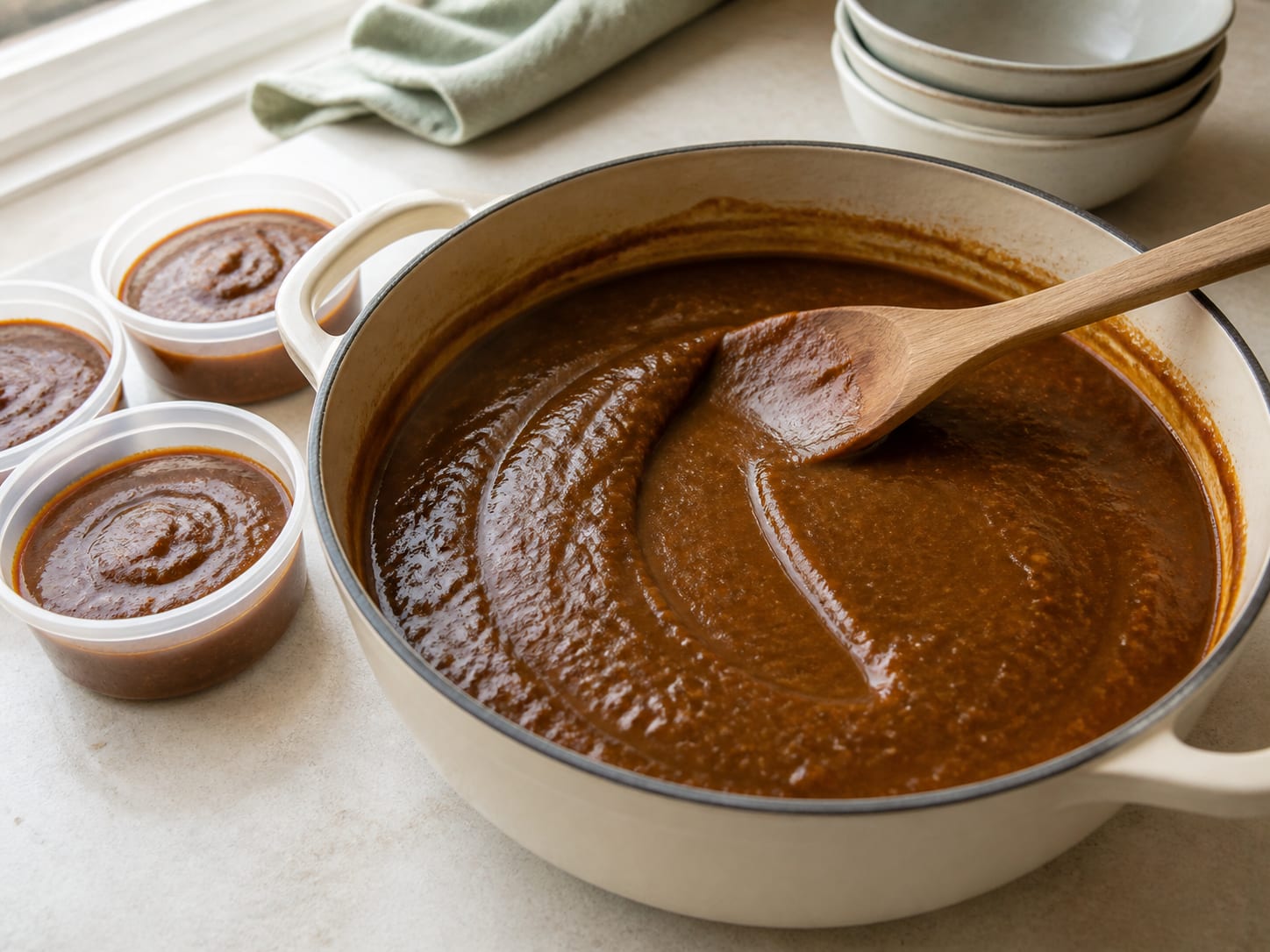
Eine dicke braune Currysauce ohne Fleisch, aufgebaut auf einer selbst gekochten Mehlschwitze und deutlich gewürzt mit Zimt und Muskatnuss. Sie bleibt neben Katsu standfest, lässt sich portionsweise einfrieren und für Curry-Udon mit Dashi verdünnen.
Vorbereitung25 Min.
Garzeit80 Min.
Portionen6
Adaptiert von Just One Cookbooks Curry-Roux, Sudachis hausgemachtem Mehlschwitze und seinem Überblick über japanische Kakushiaji und No Recipes' japanisches Curry von Grund auf neu, wobei der warme Gewürzgehalt nach dem Lesen der veröffentlichten S&B- und Ottogi-Labels und How To Japans Bericht über Osaka-Gewürzcurry absichtlich hoch ist
Zutaten
Geschrieben für: 5 L Topf
Einheiten
Temperatur
Portionen
Curry-Roux
- 80 g ungesalzene Butter gerundet
- 80 g Mehl Type 405 gerundet
- 28 g japanisches Currypulver, S&B rote Dose, oder ein mildes Currypulver gerundet
- 6 g gemahlener Zimt, mittlere Einstellung, siehe Notizen gerundet
- 3 g geriebene Muskatnuss, frisch reiben, mittlere Einstellung gerundet
- 2 g gemahlener Kardamom gerundet
- 2 g gemahlener Bockshornklee gerundet
- 2 g grob gemahlener schwarzer Pfeffer gerundet
- 0.5 g gemahlene Gewürznelken gerundet
- 1 g Cayennepfeffer (optional) gerundet
- 5 g feines Salz gerundet
Saucenbasis
- 25 ml neutrales Öl gerundet
- 600 g Zwiebeln, dünn geschnitten gerundet
- 4 Knoblauchzehen, fein gerieben gerundet
- 20 g frischer Ingwer, fein gerieben gerundet
- 120 g Apfel, geschält und gerieben, eine säuerliche Sorte wie Boskoop gerundet
- 1 1/6 L Hühner- oder Gemüsebrühe gerundet
- 20 ml Sojasauce gerundet
- 25 ml Tonkatsu-Sauce, oder Ketchup und Worcestershiresauce zu gleichen Teilen gerundet
- 15 g Honig gerundet
- nach Geschmack feines Salz gerundet
Zum Abschluss
- 7 g Garam Masala, vom Herd genommen untergerührt, nicht mitgekocht gerundet
Zubereitung
- Zuerst die Mehlschwitze zubereiten, denn sie braucht ungeteilte Aufmerksamkeit. Die Butter in einem kleinen schweren Topf bei mittlerer bis niedriger Hitze schmelzen, das Mehl einrühren und 20 bis 25 Minuten ständig bewegen. Die Mischung wird erst blass, dann sandig und schließlich erdnussbutterfarben und duftet nach gerösteten Keksen. Gegen Ende dunkelt sie schnell nach, deshalb am Herd bleiben. Angebrannte Mehlschwitze wird bitter und lässt sich nicht retten.
- Nehmen Sie die Pfanne vom Herd und rühren Sie Currypulver, Zimt, Muskatnuss, Kardamom, Bockshornklee, schwarzer Pfeffer, Nelken, Cayennepfeffer und Salz ein. Die Restwärme blüht sie, ohne sie hart zu kochen. Rühren Sie eine Minute lang, kratzen Sie die Mehlschwitze in eine Schüssel und stellen Sie sie beiseite. Es versteift sich, wenn es abkühlt, was Sie wollen.
- Das Öl in einem breiten, schweren Topf erhitzen. Fügen Sie die Zwiebeln mit einer Prise Salz hinzu und kochen Sie sie bei mittlerer Hitze 25 bis 30 Minuten lang unter Rühren alle paar Minuten, bis sie zusammenklappen und an den Rändern richtig braun werden. Dies ist der längste Schritt und derjenige, den die Leute kürzen. Die Hälfte der Farbe und der größte Teil der Süße der fertigen Sauce kommen von hier, nicht von den Gewürzen.
- Fügen Sie den Knoblauch und den Ingwer hinzu und kochen Sie ihn eine Minute lang, dann den geriebenen Apfel und kochen Sie weitere zwei Minuten, bis er aufhört, roh zu riechen.
- Die Brühe einfüllen. Fügen Sie die Sojasauce, die Tonkatsu-Sauce und den Honig hinzu. Zum Köcheln bringen, den Schaum abschöpfen und 20 Minuten unbedeckt gehen lassen. Sie möchten die Lautstärke ein wenig verringern, bevor die Mehlschwitze eingeht.
- Geben Sie etwa 250 ml der heißen Flüssigkeit in die Schüssel mit Mehlschwitze und schlagen Sie sie glatt, dann gießen Sie sie unter Rühren zurück in den Topf. Das erste Lockern der Mehlschwitze ist der einzige zuverlässige Weg, um Klumpen zu vermeiden.
- 12 bis 15 Minuten unbedeckt leicht köcheln lassen, dabei häufig umrühren und den Boden abkratzen. Dicke Sauce isoliert den Boden des Topfes und wird sich verfangen, wenn Sie ihn verlassen. Stoppen Sie, wenn es das Ziel in den Notizen unten trifft.
- Nehmen Sie den Topf vom Herd und rühren Sie die Garam Masala ein. Dies ist aus einem bestimmten Grund ein eigener Schritt: Zimt, Kardamom und Nelken tragen ihr Aroma in flüchtigen Ölen, die bei anhaltender Hitze abkochen, so dass eine Mischung, die am Anfang hinzugefügt wird, als Hintergrund endet und dieselbe Mischung, die am Ende eingerührt wird, an der Vorderseite des Mundes sitzt. Dies ist der Schritt, der Ihnen den Zimt und die Muskatnuss bringt, an die Sie sich erinnern.
- Lassen Sie es 10 Minuten stehen und salzen Sie es dann richtig. Hausgemachte Mehlschwitze enthält fast kein Salz, während ein Ladenblock hauptsächlich aus Salz und Mehl besteht, so dass hier ein untergewürztes Curry fixiert wird. Probieren Sie es auf einem Löffel einfachen Reis, nicht vom Löffel, denn Reis dämpft Salz.
- Servieren oder abkühlen und portionieren für den Gefrierschrank.
Hinweise
- **Warum ein Scratch-Roux und kein Block. ** Auf dem veröffentlichten S&B Golden Curry-Etikett steht Weizenmehl, Öle, Zucker, Salz, Currypulver mit 7,7 Prozent (Kurkuma, Koriander, Kreuzkümmel, Bockshornklee, Orangenschale, Gewürz), Geschmacksverstärker, Farbstoff, Gewürze (Pfeffer, Knoblauch, Selleriesamen, Senf), Alsäure. Es ist nirgendwo Zimt und keine Muskatnuss darauf angegeben, und Ottogis koreanisches Currypulver deklariert auch keine, also kann kein Block und kein koreanisches Pulver das sein, woran Sie sich erinnern. Wenn Sie diese beiden Gewürze an der Vorderseite haben möchten, müssen sie Linienelemente sein, die Sie kontrollieren, was bedeutet, dass Sie die Mehlschwitze selbst bauen müssen.
- **Wischen Sie es ein. ** Das ist der Punkt des Rezepts. Kochen Sie es dreimal, ändern Sie nur diese beiden Zahlen, und Sie werden Ihr Gedächtnis finden. Niedrig: 3 g Zimt, 1,5 g Muskatnuss. Das ist ungefähr der Ort, an dem normalerweise ein guter Scratch-Roux sitzt, warm, aber im Hintergrund. Mitte: 6 g Zimt, 3 g Muskatnuss, was oben geschrieben steht, wo beide im ersten Schluck deutlich erkennbar sind. Hoch: 10 g Zimt, 5 g Muskatnuss, wobei die Sauce zuerst ein warmes Curry und ein herzhaftes Curry als zweites liest. Halten Sie alles andere jedes Mal repariert. Wenn die hohe Einstellung wie ein Weihnachtsmarkt schmeckt, ziehen Sie die Nelken heraus, bevor Sie den Zimt berühren, denn Nelken ist das, was ein Curry am schnellsten ins Backgebiet treibt. Ein 5 cm langer Cassia-Stick und ein Sternanis, der in Schritt 5 in den Topf fallen gelassen und vor dem Servieren herausgefischt wird, fügen Sie eine rundere, weniger pudrige Version derselben Note hinzu.
- **Das Garam-Masala-Verhältnis. ** Ungefähr ein Teil Garam Masala zu vier Teilen japanisches Currypulver, von der Hitze hinzugefügt. Japanisches Currypulver besteht hauptsächlich aus Kurkuma, Koriander, Kreuzkümmel und Bockshornklee, mit warmen Gewürzen zu vielleicht einem Prozent der Mischung. Die Zugabe eines Viertels seines Gewichts in Garam Masala nimmt warme Gewürze zu den hohen Teenagern als Anteil an der gesamten Gewürzbelastung. Das ist ein anderes Gericht, keine Optimierung.
- **Was Sie tatsächlich verfolgen könnten. ** Osaka-Gewürzcurry, スパイスカレー, ist ein Kansai-Stil, der in den 2000er Jahren außerhalb der Standardrezepttradition aufgewachsen ist. Seine Kerngewürze sind Kurkuma, Koriander, Zimt, Kreuzkümmel und schwarzer Pfeffer, und jeder Laden baut eine Signatur um ein ausgewähltes Gewürz auf. Ein Geschäft, dessen gewähltes Gewürz Zimt ist, produziert genau das, was Sie beschreiben, und es wird niemals mit einem Hausrezept für Kare Raisu übereinstimmen, weil es nicht versucht, eines zu sein. Das ist der wahrscheinlichste Grund, warum Sie es gegessen haben und es nie aufgeschrieben gefunden haben.
- **Konsistenz und wie man sie testet. ** Das Ziel ist dick genug, um zu mun. Ziehen Sie einen Spatel über den Boden des Topfes: Die Schiene sollte etwa zwei Sekunden lang offen bleiben und sich dann langsam schließen. Wenn es sofort schließt, ist es zu dünn, und wenn es überhaupt nicht schließt, ist es zu dick. Auf einem Teller sollte es eine saubere Kante für eine Minute gegen einen Reishügel halten, anstatt zum Rand zu laufen, und auf der Rückseite eines Löffels sollte eine Fingerlinie durch ihn hindurch offen bleiben. Was es verdickt: mehr köchelnd unbedeckt, mehr Mehlschwitze (rechnen Sie 40 g Mehlschwitze pro 250 ml Flüssigkeit) und einfach abkühlen, da es spürbar festsetzt, wenn es unter die Handtemperatur fällt. Was es ausdünnt: Brühe, Wasser, Dashi und alles, was zu spät hinzugefügt wird. Es sieht im Topf immer dünner aus, als es auf dem Teller sein wird, also stoppen Sie einen Schatten, bevor Sie denken, dass Sie es sollten.
- **Die Tiefenbauer, ehrlich gesagt. ** Geriebener Apfel macht etwas Echtes, und nicht aus dem normalerweise angegebenen Grund. Es bringt Säure und Pektin genauso viel wie Süße, und das Pektin hilft der Sauce, zusammenzuhalten. Behalte es. Honig rundet den Rand des Gewürzs in der kleinen Menge ab, die hier verwendet wird, und ist die zwei Sekunden wert. Tonkatsu-Sauce ist die nützlichste von vielen: Sie ist bereits eine gekochte Obst- und Gemüsesauce mit Essig, Umami und ausgewogener Süße, so dass sie in einem Löffel das tut, was drei separate Zugaben tun würden. Ein Quadrat dunkler Schokolade mit 2 bis 3 g ist keine Folklore, aber es ist nah dran: Es verdunkelt die Farbe und fügt eine Spur von Bitterkeit hinzu, und Sie würden Schwierigkeiten haben, es zu benennen. Instantkaffee, ein halber Teelöffel, macht die gleiche Arbeit wie Schokolade und ist offensichtlicher, was manche Leute mögen und andere nicht. Keiner von beiden repariert ein Curry, und beide werden häufig zum Abdecken von Zwiebeln verwendet, die nicht lange genug gebräunt wurden. Die Zwiebeln richtig anbraten und Sie werden beides nicht verpassen. Was wirklich Folklore ist, ist die Behauptung, dass jeder von ihnen das Curry “reicher” macht: Was es reich macht, ist das Fett in der Mehlschwitze und der Zucker in den Zwiebeln.
- **Portionieren und Einfrieren. ** Kühlen Sie die Sauce auf Raumtemperatur ab und teilen Sie sie dann in 250 ml Portionen, die eine Platte Curryreis oder die Basis für eine Schüssel Curry Udon sind. Flache Gefrierbeutel flach gelegt, schneller einfrieren, besser stapeln und in zwanzig Minuten in einer Schüssel mit Wasser auftauen. Verschraubte Gläser funktionieren, lassen aber 2 cm Kopfraum. Es hält sich vier Monate gefroren und fünf Tage im Kühlschrank, und es ist so oder so am zweiten Tag besser. Erwärmen Sie es vorsichtig mit einem Spritzer Wasser, da es im Gefrierschrank weiter eindickt und sich in einer heißen Pfanne verfangen kann, wenn Sie es überstürzen.
- **Drei Routen aus einer Charge. ** Über Reis mit einem geschnittenen Hähnchen lehnte sich Katsu daran, gegossen neben das Kotelett und nicht über die Kruste. Als einfacher Curryreis, mit Fukujinzuke am Rand. Oder grob eins zu eins mit Dashi verdünnt, eine kleine Stärkeaufschlämmung gegeben und über Udon gegossen, was das Kare-Udon-Rezept ist. Die Sauce ist absichtlich dicker als ein Curry, das man direkt aus dem Topf essen würde, denn jeder dieser drei Verwendungen setzt es entweder gegen Reis oder verdünnt es.
- **Hinzufügen von Eiweiß und Gemüse. ** Dies ist die Sauce allein, also braucht nichts darin eine festgelegte Garzeit und sie fällt beim Aufwärmen nie auseinander. Um es zu einem vollen Curry zu machen, bräunen Sie 600 g Hähnchenschenkel oder Rinderfutter im Topf vor den Zwiebeln, legen Sie es beiseite, geben Sie es bei Schritt 5 zurück und fügen Sie in den letzten 20 Minuten 400 g Wachskartoffeln und 200 g Karotten hinzu. Für ein veganes Tofu-Curry verwenden Sie Gemüse- oder Pilzbrühe, sardellenfreier Worcestershire und 600 g extra festen Tofu: Drücken Sie ihn, oder köcheln Sie ihn stattdessen 3 Minuten im Ganzen in Salzwasser (siehe die Tofu-Grundformel), reißen Sie ihn von Hand in grobe Stücke, bräunen Sie ihn separat an und falten Sie ihn 2 Minuten lang in die fertige Sauce. Frieren Sie es nicht mit Kartoffeln ein, da die Kartoffel im Gefrierschrank körnig und wässrig wird. Frieren Sie die Sauce einfach ein und fügen Sie die Kartoffel hinzu, wenn Sie sie wieder aufwärmen.
- **Einkaufen in Deutschland. ** S&B Currypulver in der kleinen roten Dose ist in den meisten Asia-Märkte und in jedem deutschen Online-Shop in Asien erhältlich. Ein mildes Supermarkt-Currypulver plus das Garam Masala bringt Sie näher, da die Hauptlücke Orangenschale und Bockshornklee ist. Garam Masala ist in jedem indischen oder türkischen Lebensmittelhändler und in den größeren Gewürzregalen von Rewe und Edeka erhältlich. Gemahlenes Bockshornkleepulver ist Bockshornkleepulver, das in türkischen Geschäften und Reformhäusern verkauft wird. Tonkatsu-Sauce bedeutet Bulldogge oder Kagome, nur Asia-Markt, und gleiche Teile Ketchup und Worcestershire-Sauce mit einer Prise Zucker ist ein fairer Stand-in. Kaufen Sie ganze Muskatnuss und reiben Sie sie; vorgemahlene Muskatnuss verliert das meiste, was es wert ist, innerhalb weniger Monate zu haben, und bei 3 g in einem Topf werden Sie den Unterschied schmecken.
- Fehlerquellen. Zu schnell gebräunte Mehlschwitze schmeckt verbrannt und lässt sich nicht mit Brühe retten. Wird sie trocken eingerührt, entstehen Klumpen. Nach ihrer Zugabe darf die Sauce nur sanft köcheln, da sie bei starker Hitze körnig werden kann. Eine fade Sauce braucht fast immer Salz statt zusätzlicher Gewürze. Schmeckt sie nach rohem Mehl, muss sie weitere zehn Minuten köcheln.
Verwendete Quellen
- Just One Cookbook: How to Make Japanese Curry Roux
- Sudachi Recipes: Homemade Japanese Curry Roux
- Sudachi Recipes: Japanese Curry Using Roux Cubes, with secret ingredients
- No Recipes: Homemade Japanese Chicken Curry from Scratch
- How To Japan: Spice Curry, the New Wave from Osaka
- Ovii: When and how to add garam masala
Passt gut zu
Verwendete Quellen
Von Christoph Mayer