
Suppe Deutsch Europäisch Nussfrei
Gaisburger Marsch
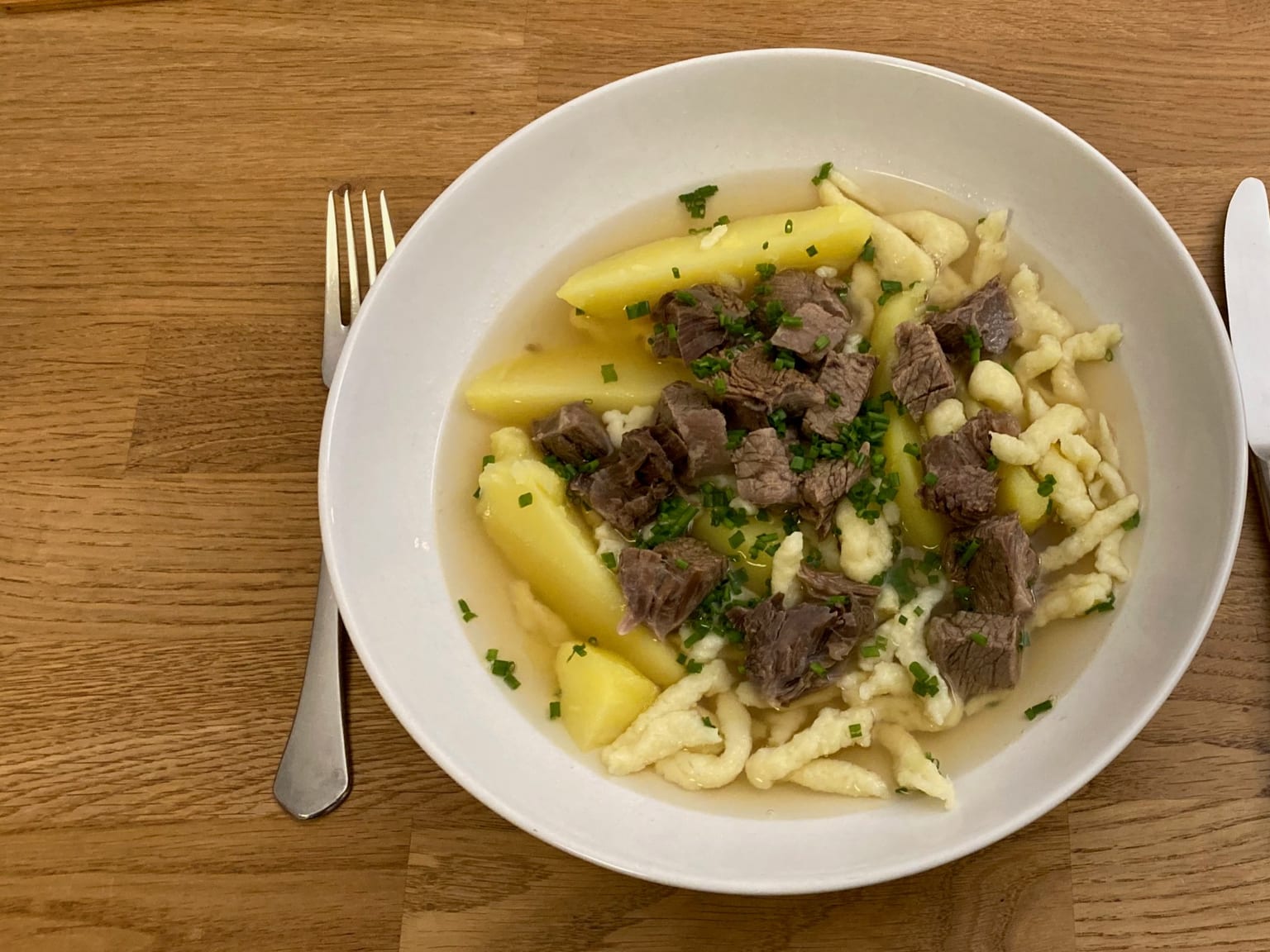
Stuttgarts Eintopf-Klassiker. Eine klare Rinderbrühe mit gekochtem Rindfleisch, Kartoffeln und Spätzle in der gleichen Schüssel, abgerundet mit in Butter gebräunten Zwiebeln. Suppe nach Namen, Abendessen nach Gewicht.
Christophs eigene Version, erstellt aus drei deutschen Rezepten (Küchengötter's Stuttgarter Gaisburger Marsch, Einfach Kochen und Küche Gemacht) und mit den deutschen und englischen Wikipedia-Einträgen für die Komponenten und den Namen abgeglichen.
Zutaten
Geschrieben für: 6 L Topf
Einheiten
Temperatur
Portionen
Brühe und Fleisch
- 800 g Rinderbeinscheibe oder Bugblatt, in ein bis zwei großen Stücken gerundet
- 500 g Markknochen gerundet
- 2 1/2 L kaltes Wasser gerundet
- 1 Zwiebel, groß, halbiert, mit Schale gerundet
- 2 Gewürznelken gerundet
- 1 Lorbeerblatt gerundet
- 8 schwarze Pfefferkörner gerundet
- 120 g Gelbe Rüben, grob geschnitten gerundet
- 150 g Knollensellerie, grob geschnitten gerundet
- 1 Lauch, weißer und hellgrüner Teil, längs geteilt und gewaschen gerundet
- 15 g glatte Petersilie, Stiele für die Brühe, Blätter zum Servieren gerundet
- 8 g feines Salz gerundet
Zum Fertigstellen
- 1 1/2 L abgeseihte Rinderbrühe, Ertrag aus dem Topf oben, notfalls mit gekaufter Brühe aufgefüllt gerundet
- 500 g festkochende Kartoffeln, geschält, 1,5 cm gewürfelt gerundet
- 300 g gekochte Spätzle, frisch abgepackt oder selbst gemacht gerundet
- 250 g Zwiebeln, dünn geschnitten gerundet
- 40 g Butter gerundet
- nach Geschmack frisch geriebene Muskatnuss gerundet
- nach Geschmack feines Salz gerundet
- nach Geschmack schwarzer Pfeffer gerundet
- 10 g Schnittlauch, fein geschnitten (optional) gerundet
Angaben zur Ernährung sind ein Anhaltspunkt, keine Garantie. Bei einer Allergie bitte die Zutaten selbst prüfen.
Zubereitung
- Das Rindfleisch und die Knochen in den Topf geben, mit kochendem Wasser bedecken und 2 Minuten lang hart kochen. Abgießen, das Fleisch und den Topf abspülen und von vorne beginnen. Dieser eine Schritt ist der Grund, warum die fertige Brühe klar ist.
- Trocknen Sie den leeren Topf, stellen Sie ihn auf hohe Hitze und drücken Sie die Zwiebelhälften mit der Schnittseite nach unten, bis sie richtig dunkel sind. Diese Farbe geht in die Brühe und nichts anderes ersetzt sie.
- Fügen Sie Fleisch, Knochen, kaltes Wasser, Salz, Nelken, Lorbeere und Pfefferkörner hinzu. Bringen Sie es langsam zum Kochen und schöpfen Sie den grauen Schaum ab, während er aufgeht. Niemals kochen lassen, sonst wird die Brühe trüb.
- 1 Stunde unbedeckt köcheln lassen, dann Karotten, Sellerie, Lauch und Petersilienstiele hinzufügen. Weitere 60 bis 75 Minuten köcheln lassen, bis eine Gabel ohne Widerstand in das Rindfleisch gleitet.
- Heben Sie das Rindfleisch heraus und wickeln Sie es in Folie ein. Die Brühe durch ein mit Stoff auskleidung ausgekleidetes Sieb abseihen und das Fett abschöpfen. Sie sollten 1,5 bis 1,8 Liter haben. Probieren Sie es und würzen Sie es fest; alles andere in der Schüssel ist von selbst fade.
- Die Brühe wieder in den sauberen Topf geben, die gewürfelten Kartoffeln hinzufügen und 15 bis 20 Minuten köcheln lassen, bis sie gerade weich sind. Lass sie nicht zusammenbrechen.
- Während die Kartoffeln kochen, die Butter in einer breiten Pfanne schmelzen, die geschnittenen Zwiebeln mit einer Prise Salz hinzufügen und bei mittlerer bis niedriger Hitze 20 bis 25 Minuten unter häufigem Rühren kochen, bis sie tief golden sind. Reduzieren Sie die Hitze, wenn sie fangen.
- Das Rindfleisch in 2 cm große Würfel schneiden. Das Rindfleisch und die Spätzle in die Brühe geben und 2 bis 3 Minuten erhitzen. Mit Muskatnuss, Salz und Pfeffer würzen.
- In tiefe Schüsseln geben, damit jede Schüssel Fleisch, Kartoffeln und Spätzle bekommt. Mit den gebräunten Zwiebeln belegen, dann die Petersilienblätter und den Schnittlauch.
Hinweise
- Der Name ist nicht festgelegt. Die drei im Umlauf befindlichen Erklärungen sind, dass Offizierskadetten aus dem 19. Jahrhundert aus ihrer Stuttgarter Kaserne in ein Gaisburg-Gasburger Gasthaus marschierten, dass Ehefrauen von inhaftierten Gaisburger Männern den Topf täglich zu Fuß zu ihnen trugen und dass “Marsch” einfach den Marsch von Zutaten in eine Schüssel beschreibt. Die deutsche Wikipedia behandelt alle drei als Legende und stellt fest, dass die früheste schriftliche Aufzeichnung aus dem Jahr 1933 stammt. Erzählen Sie also, welche Geschichte Sie mögen, und behaupten Sie nicht, dass es die wahre ist.
- Die Brühe ist das ganze Gericht, also machen Sie es einen Tag im Voraus. Kühlen Sie es über Nacht, heben Sie das feste Fett von der Oberseite ab, und Sie erhalten eine sauberere und besser gewürzte Suppe mit einer Stunde Arbeit, die vom Tag, an dem Sie sie servieren, entfernt wird.
- Kartoffeln und Spätzle in der gleichen Schüssel ist der Punkt, kein Zufall. Die Schwaben nennen die Kombination “Verheierte”, die Verheirateten.
- Verwenden Sie wachsartige Kartoffeln. Die Schwaben nennen sie Grombira oder Grundbirnen. Mehlige lösen sich in der Brühe auf und trüben sie.
- Frisch gekühlte Spätzle aus dem deutschen Supermarkt ist eine ziemliche Abkürzung, aber selbstgemacht ist hier merklich besser, weil die Brühe so wenig anderes enthält. Fügen Sie sie ganz am Ende hinzu; Spätzle, der in heißer Brühe sitzt, wenden Sie sich zum Pasten.
- In Deutschland fragen Sie den Metzger nach Beinscheibe oder Bugblatt plus Markknochen. In Kanada sind Rinderkeule und Chuck mit ein paar Suppenknochen das Äquivalent, und die Markknochen sind in der Regel billig.
- Die Zwiebeln richtig anbraten. Blasse Zwiebeln oben sehen aus wie eine Beilage; dunkle schmecken wie das Gericht.
- Reste halten sich 3 Tage, aber die Brühe, das Fleisch und die Kartoffeln und die Spätzle separat aufbewahren und beim Aufwärmen vermischen.
- Dies ist kein Keto-Rezept.
Verwendete Quellen
- Küchengötter: Stuttgarter Gaisburger Marsch
- Einfach Kochen: Gaisburger Marsch nach Omas Originalrezept
- Küche Gemacht: Gaisburger Marsch
- Wikipedia (DE): Gaisburger Marsch
- Wikipedia (EN): Gaisburger Marsch
Passt gut zu
Verwendete Quellen
Von Christoph Mayer